
Does My Dryer Vent Need a Booster Fan?
Does your dryer vent need a booster fan? Learn when a listed power ventilator may be considered, what to inspect first, and why cleaning is not installation.
The short answer
Not automatically. A long or restrictive dryer exhaust route may require a listed dryer exhaust duct power ventilator, but the route, dryer instructions, locally adopted code, and product listing must be checked first. A generic inline duct booster fan is not a substitute. Cleaning can remove accessible lint, but it does not design, install, wire, approve, or repair a power ventilator.
Three real AirDuctVet field photos
These authentic AirDuctVet job photos were selected for this topic. We do not use repeated AI artwork or stock photography.
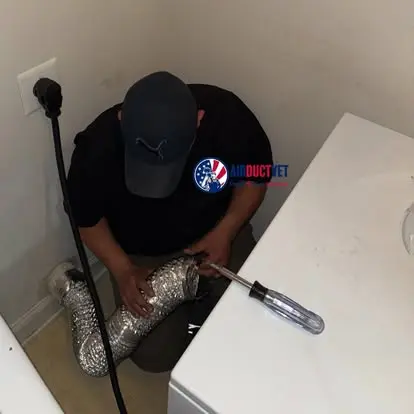 Real AirDuctVet photo
 Real AirDuctVet photo
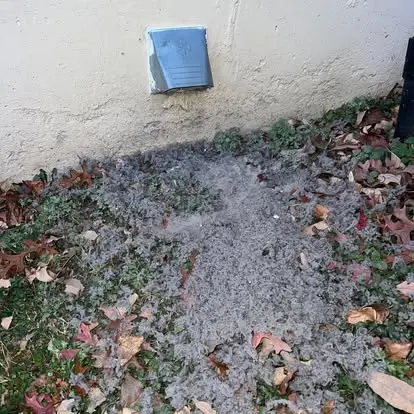 Real AirDuctVet photo
Clear, practical guidance: General education cannot replace an on-site inspection. We separate routine maintenance from conditions that need an HVAC, appliance, chimney, mold, or restoration specialist.
Does my dryer vent need a booster fan?
A power ventilator may be considered when the dryer's permitted exhaust length cannot serve the actual route and a code-compliant redesign is not practical. That conclusion depends on the appliance instructions, equivalent duct length, number and type of fittings, termination, local code, and a product specifically listed and installed for dryer exhaust.
Do not assume a fan is required because clothes take longer to dry or the duct travels upward. Those symptoms can come from accessible lint, a crushed transition connection, a blocked damper, nest material, a disconnected or damaged duct, an appliance problem, or a route that was never suitable for the dryer.
What is the difference between a power ventilator and a generic booster fan?
The 2024 International Residential Code addresses domestic dryer exhaust duct power ventilators and requires them to conform to UL 705 and be installed according to the manufacturer's instructions. The same code section prohibits domestic booster fans. Local jurisdictions can adopt different editions or amendments, so the rule in force at the property must be confirmed.
Manufacturer-labeled dryer exhaust products include controls and safety features intended for that application. Fantech describes pressure-activated dryer exhaust fans for longer duct runs, and Panasonic lists a dedicated dryer exhaust duct power ventilator. A general HVAC inline fan, bathroom exhaust fan, or improvised motor is not an equivalent product simply because it fits the duct diameter.
What should be checked before adding a power ventilator?
Start with the dryer model's installation instructions and the actual exhaust path. Equivalent length is not only the straight-line distance; elbows, fittings, transition material, and termination conditions can affect the allowed route. The locally adopted code and the power ventilator's listing may add placement, access, control, maintenance, and clearance requirements.
- Confirm the dryer model, fuel type, and manufacturer instructions.
- Document the route, accessible fittings, vertical rise, and exterior termination.
- Check for a crushed connector, lint-catching screen, stuck damper, nest debris, disconnection, or damaged duct.
- Determine whether the route can be shortened, straightened, or otherwise corrected before adding equipment.
- Confirm the locally adopted code, permit requirements, product listing, electrical supply, and service access with the qualified installer.
- Obtain condominium, landlord, HOA, or building-management approval when the route or equipment is shared or controlled by others.
Can dryer vent cleaning solve the airflow problem?
Cleaning can help when accessible lint or debris is the restriction. It cannot correct excessive route length, undersized or improper materials, a concealed disconnection, poor fitting layout, an indoor termination, shared exhaust, electrical controls, or a failed appliance. A route can also have more than one problem at the same time.
AirDuctVet can document accessible conditions, the visible transition, the termination, and selected reachable sections within the approved scope. A Cobra inspection camera may help view portions of a dryer vent, but it cannot pass every bend, prove every concealed joint is sound, calculate code compliance by itself, or replace the dryer manufacturer's instructions.
Can a power ventilator make an improper vent acceptable?
No. A power ventilator does not make it acceptable to exhaust into an attic, crawl space, garage, wall cavity, or another indoor area. It does not authorize a shared duct, lint-catching screen, plastic vent hose, crushed connector, unsuitable termination, or damaged concealed ductwork.
The system must still discharge outdoors through an independent route using permitted materials and fittings. If the existing path is improper, the appropriate qualified trade should evaluate correction before anyone treats added airflow as the solution.
What installation and repair work is separate?
Routine dryer vent cleaning does not automatically include selecting or installing a power ventilator, electrical wiring, controls, duct replacement, rerouting, appliance repair, gas work, roofing, structural changes, or permit work. Those services require a separate evaluation and written approval and may belong to a licensed electrician, appliance technician, duct installer, roofer, building engineer, or other qualified trade.
A listed ventilator also needs access for inspection and maintenance. Follow its installation and service instructions rather than placing it in an inaccessible concealed space or treating it as maintenance-free.
What does AirDuctVet include and exclude?
AirDuctVet's written quote defines the approved dryer vent cleaning route, access points, and exterior work. Findings may help a customer decide whether a separate installer or repair professional is needed, but cleaning is not a code inspection, engineering review, or authorization to alter the exhaust system.
Air-duct cleaning is a separate service. Coil cleaning is not included unless the customer specifically requests it and AirDuctVet separately evaluates and approves it. Routine air-duct service also does not automatically include mechanical repair or filter replacement.
Properties in Northern Virginia, Washington, DC, Maryland, Raleigh, Cary, and Miami can have different adopted rules, building controls, roof access, and shared-system responsibilities. Choose the correct service area so the local office can review access and scope before work.
Frequently asked questions
Does every long dryer vent need a booster fan? No. The dryer instructions, equivalent length, route condition, local code, and available corrections must be evaluated first.
Can I use a regular inline duct fan? Do not substitute a general inline fan. A dryer exhaust application requires the specific listed equipment and installation allowed by the rules that apply to the property.
Will a power ventilator fix a clogged vent? It may move air differently, but it does not replace cleaning or correction of blockage, damaged ductwork, a stuck termination, or an appliance problem.
Can AirDuctVet install or wire the fan during cleaning? Not as part of routine dryer vent cleaning. Installation, wiring, controls, permits, and repairs require a separate approved scope and the appropriate qualified trade.
How often should the fan and vent be serviced? Follow the dryer and power ventilator manufacturers' instructions and service based on actual conditions. AirDuctVet does not promise one fixed interval for every property.
Will adding a fan lower my utility bill? Do not assume it will. The purpose and suitability must be established for the specific route, and AirDuctVet does not guarantee energy savings.
Sources and further reading
Official guidance informs the general information above. AirDuctVet's included services are defined by your written quote; local requirements and manufacturer instructions may differ.