
Dryer Takes Too Long to Dry? 9 Warning Signs and the Fast Fix
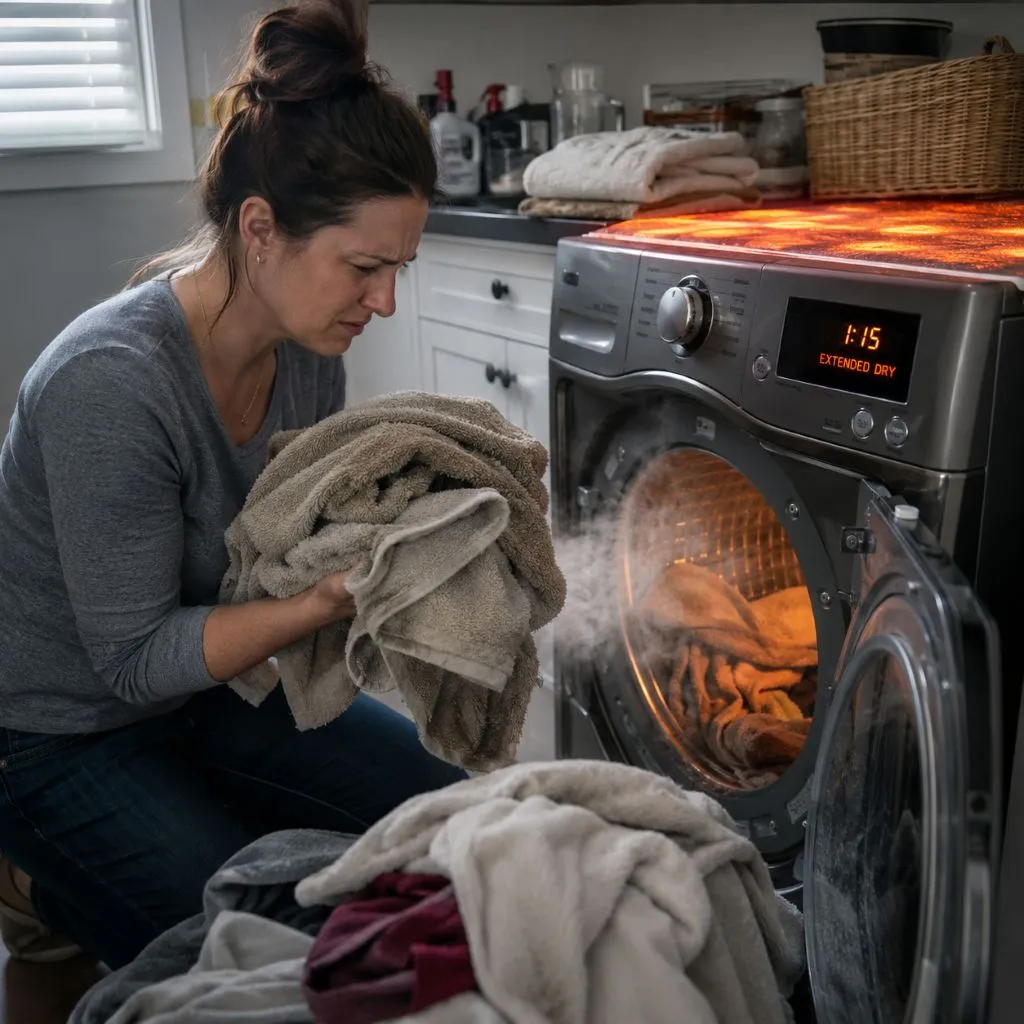
You start a load of towels Monday morning. Pull them out an hour later, still damp. So you run the cycle again. Still damp. By the third cycle, the towels are finally dry but the dryer’s so hot you can barely touch the door.
If that sounds familiar, your dryer probably isn’t broken. Your vent is choking it.
When a dryer takes too long to dry one load (two cycles where you used to get away with 45 minutes), the cause is almost never the dryer itself. After more than a decade pulling lint clogs out of dryer vents across Northern Virginia and the DMV, “my dryer takes too long to dry” is the single most common service call our team gets.
In roughly 9 out of 10 cases when a dryer takes too long to dry, the dryer is working exactly the way it was designed to. The problem is upstream, in the four-inch duct that runs from the back of your dryer to the outside of your house, where lint has built up enough to strangle the airflow your dryer depends on.
Here’s what’s actually happening, how to confirm it in about 10 minutes without any tools, and how to fix it before the fire risk catches up to the inconvenience.
Why Your Dryer Takes Too Long to Dry (the Short Version)
A dryer doesn’t just heat your clothes. It heats them and blows the moisture-laden air out of the house through your dryer vent. If that vent is restricted, the moist air has nowhere to go, so it stays inside the drum. When your dryer takes too long to dry, that’s almost always what’s happening: your clothes are getting hot, but the moisture can’t escape.
The whole machine works harder, runs longer, gets hotter. Eventually, if you ignore it long enough, it either trips its thermal fuse and stops heating altogether or it sets fire to the lint that’s been baking inside the vent for months.
According to the National Fire Protection Association, U.S. fire departments respond to thousands of home fires involving clothes dryers every year. Failure to clean is listed as the single leading contributing factor in roughly one out of every three of those fires.
So if your dryer takes too long to dry, running 2 or 3 cycles to finish one load, you’re not being impatient. You’re being warned.
Why This Feels Sudden When It Really Isn’t
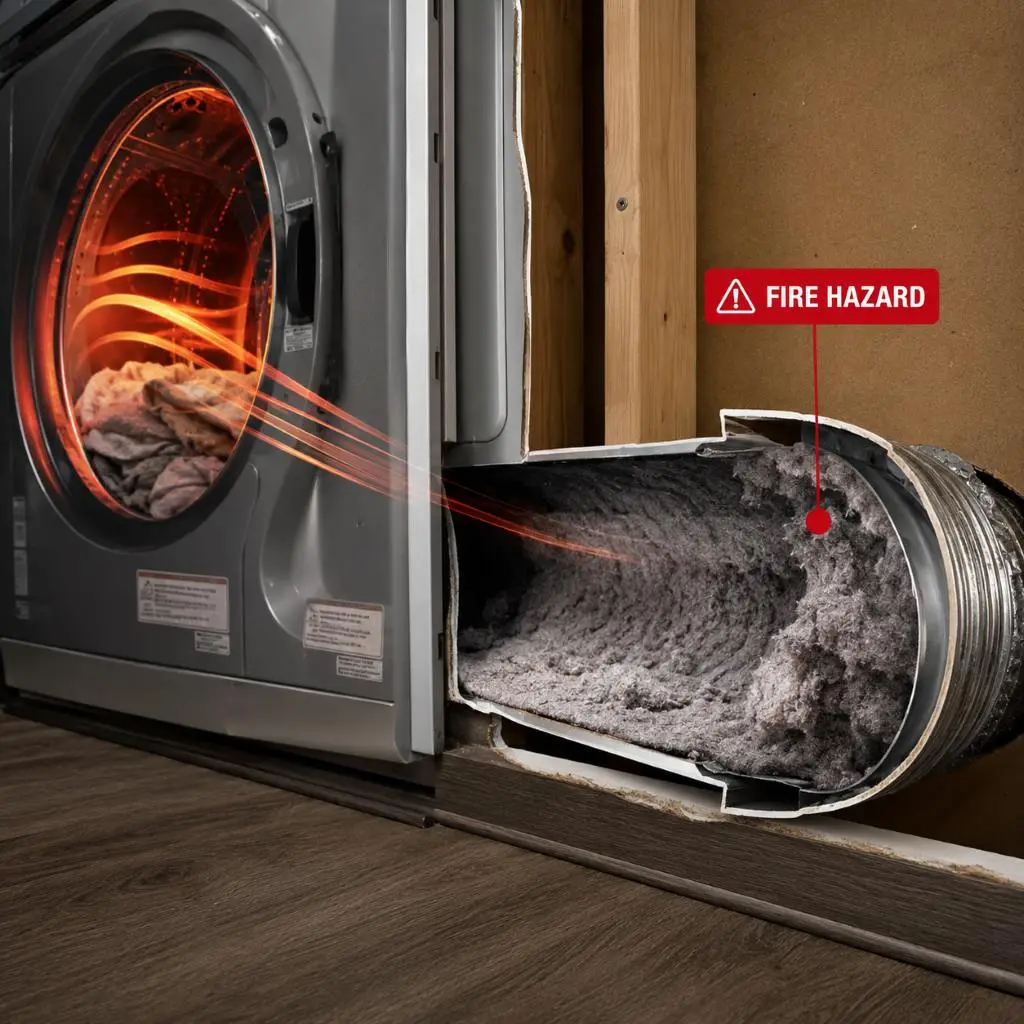
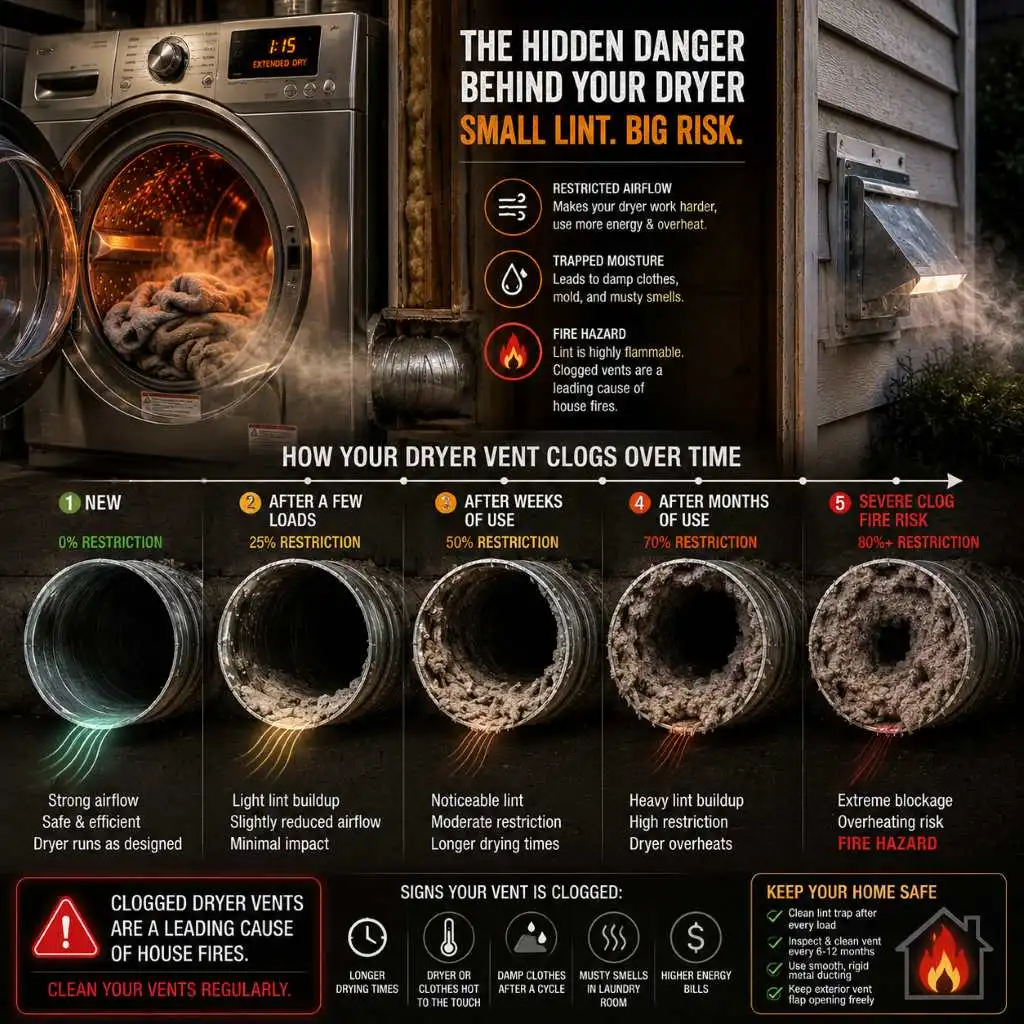
Lint doesn’t show up all at once. It builds, layer by layer, over years. The first few inches of buildup might cost you 5% efficiency, and you’d never notice. The next half-inch costs another 10. By the time you actually notice your dryer takes too long to dry, your vent is probably 60 to 80% obstructed.
Most homeowners don’t realize their dryer takes too long to dry until a single tipping-point load, usually heavy towels or a comforter, pushes the system past where it can compensate. Then it feels sudden. It wasn’t sudden. You just hit the threshold.
This matters because it means “a few more months” isn’t a safe wait. By the time you’ve noticed, the system is already operating in the danger zone.
9 Signs Your Vent Is the Actual Problem (Not Your Dryer)
When your dryer takes too long to dry, here are the warning signs that point to vent restriction rather than a mechanical failure. If you can check off 3 or more of these, the diagnosis is essentially settled before a technician walks in the door.
- Clothes come out hot but still damp. The dryer is generating heat but can’t expel moisture.
- The dryer itself is hot to the touch. The back panel and sides shouldn’t be uncomfortable to handle. If they are, the heat that should be exhausting outside is staying inside the cabinet.
- There’s a burning or musty smell during cycles. Burning means lint is heating up against the heating element. Musty means moisture is sitting in the duct and microbial growth has started.
- The laundry room feels humid or hot after a cycle. That’s water vapor that should have left the building.
- The lint trap fills faster than it used to. Restricted airflow doesn’t catch lint efficiently, so more makes it past the trap and into the duct itself.
- The outside vent flap doesn’t open when the dryer’s running. Go outside while a cycle is running. If the exterior hood flap isn’t blowing open and you can’t feel strong, warm airflow, almost no air is getting through.
- Cycle times have crept up over months. If you used to dry a load in 45 minutes and now it takes 90, that’s the slow creep of accumulation.
- The dryer shuts off mid-cycle. This is the thermal fuse doing its job, cutting power to prevent fire. Many homeowners assume their dryer “broke.” The thermal fuse blew because airflow was too restricted to cool the heating element.
- It’s been more than 12 months since your last vent cleaning. The NFPA and most manufacturers recommend annual cleaning at minimum. Larger households need it more often.
If three or more of these match what you’re seeing, your dryer takes too long to dry because of vent restriction, full stop. The next section walks you through how to confirm it without calling anyone.
How to Diagnose It Yourself in 10 Minutes
Before assuming your dryer takes too long to dry because something inside the cabinet is broken, run these four checks. They cost nothing and rule in or out the vent in about 10 minutes.
Step 1: Watch the Outside Vent During a Cycle
Start a normal heat cycle. Walk outside. Find the exterior vent hood, usually 8-15 feet from your dryer on an outside wall or rooftop. Within 2-3 minutes the flap should swing open and you should feel strong, warm airflow strong enough to flutter a sheet of paper held a foot away.
No flap movement, weak airflow, or cool air all point to a restricted vent. When your dryer takes too long to dry, this is the single fastest field test. If you want to see exactly how the exterior cleaning approach works, we walk through it step by step. There’s also a longer discussion of whether to clean from inside or outside that’s worth reading before you start.
Step 2: Disconnect and Inspect the Transition Hose
Unplug your dryer. Pull it forward carefully, especially with gas units, and don’t strain the gas line. The flexible hose connecting the dryer to the wall is the transition duct. Disconnect it from the wall side. Look inside. If you see a layer of compressed lint coating the walls, that’s just the visible part. The rigid duct inside the wall is almost certainly worse.
While you’re back there, check what the hose is made of. White vinyl or thin foil hoses are fire hazards and violate IRC M1502 in most jurisdictions, including Virginia. They should be replaced with rigid metal or semi-rigid aluminum.
Step 3: Feel the Dryer Back Panel After a Cycle
Run a 20-minute cycle with the dryer in normal position. Touch the back panel. Warm is fine. Hot enough that you pull your hand back is a sign the dryer is retaining heat it should be exhausting.
Step 4: Check the Lint Trap Housing Itself
Pull out the lint screen. Use a flashlight to look into the slot. Lint hiding below the screen is a strong indicator that exhaust resistance is pushing lint where it shouldn’t be.
When It’s Not the Vent (the 4 Other Real Causes)
If your dryer takes too long to dry but the vent checks out clean, the cause sits in one of these four places.
A Failed Heating Element (Electric Dryers Only)
If your dryer runs full cycles but never produces heat at all (not just less heat), the element may have burned out. Worth noting though: heating elements rarely fail in isolation. The leading cause of premature heating element failure is restricted airflow forcing the element to run hotter than designed. So even if you do need a new element, fixing the vent is what keeps the next one from burning out too.
A Blown Thermal Fuse
Thermal fuses are one-time safety devices that blow when the dryer cabinet exceeds a set temperature, usually around 196°F. When a dryer takes too long to dry and then suddenly stops heating entirely, a blown thermal fuse is usually the proximate cause. Replacing the fuse without addressing the underlying airflow restriction means it will blow again within days or weeks.
A Damaged Blower Wheel
The blower wheel is the impeller that pushes air through the vent system. If it’s cracked, broken, or clogged with lint, airflow drops even if the vent itself is clear. You’ll usually hear a thumping or scraping sound, and the symptoms can mimic a vent clog.
Overloading the Drum
A modern dryer drum is sized for one full-size washer load. Cramming a king comforter, three towels, and a load of jeans into one cycle exceeds tumble capacity, and air can’t circulate through the load. The clothes spend the entire cycle in a damp clump in the middle. This one’s free to fix. Split the load.
Why “Hot but Not Drying” Is the Dangerous Symptom
When your dryer takes too long to dry AND runs noticeably hot, that’s the highest-risk combination in the entire failure profile. The dryer isn’t failing safely. It’s failing in the worst possible mode.
Here’s the chain of events. Restricted airflow means the heating element runs longer per cycle. Longer heating runs raise the temperature inside the duct. Lint inside that duct has an ignition temperature around 400°F. The high-limit thermostat is supposed to cut the heating element off before that. But if the thermostat is older, partially obstructed by lint, or operating at the edge of its tolerance, it may not cut in time.
The U.S. Fire Administration reports that clothes dryer fires account for thousands of residential fires every year, causing dozens of deaths and hundreds of injuries. We’ve written separately about the 5 deadly risks of a clogged dryer vent. Every one of them shows up in NFPA case data exactly the way it’s described.
The single highest-risk pattern is exactly what you’re experiencing: a dryer that takes too long to dry, runs hot, and hasn’t been cleaned in over a year. The longer your dryer takes too long to dry without intervention, the closer you’re standing to a fire. Not “could.” The failure mode is well-documented in NFPA case data.
What You Can Safely Do Yourself (and Where to Stop)
Once you’ve confirmed your dryer takes too long to dry because of vent restriction, some of the fix is genuinely DIY territory. Some of it isn’t. If you want the full walkthrough, we’ve published a complete DIY dryer vent cleaning guide that covers tools, techniques, and limits. Below is the short version.
What you can do safely on your own:
- Pull the lint screen and clean it after every load. Use a vacuum attachment to clear the lint trap housing every month or two.
- Disconnect the dryer (unplug for electric, shut off gas valve for gas) and clean the transition hose. Replace it with rigid metal or semi-rigid aluminum if it’s vinyl or foil.
- Clean the first 4-6 feet of the vent duct using a dryer vent brush kit and a shop vac. These kits run $25-40 at any hardware store. You can clean a dryer vent without removing the dryer in most homes, though it requires the right brush attachment and patience.
- Clear the exterior vent hood. Remove any pest screens or covers that aren’t supposed to be there.
What you should not use, no matter what YouTube tells you:
- A leaf blower. It seems efficient and isn’t. We’ve explained why leaf blowers actually make the problem worse. Short version: they push lint deeper and blow it back into your house.
- A plumbing snake. Wrong tool for the job. Plumbing snakes can damage your vent duct and don’t actually remove lint, they just compress it.
When you should stop and call a pro:
- Vent runs longer than 6 feet, especially with bends. Brush kits can’t navigate elbows reliably.
- Roof-vented systems. Working on a roof for a dryer vent is genuinely dangerous and not worth the risk.
- Visible mold or signs of pest activity.
- Any time you’ve reset a blown thermal fuse and it blew again.
- Any burning smell that doesn’t go away after surface cleaning.
If your dryer takes too long to dry despite your DIY attempts, that’s the signal to bring in professional equipment.
What Professional Dryer Vent Cleaning Actually Involves
When your dryer takes too long to dry despite DIY cleaning, professional service is what closes the gap. A real cleaning isn’t somebody showing up with a shop vac.
Here’s what we do on every AirDuctVet dryer vent service, and what any honest, qualified company should be doing.
We start with a full-length camera inspection. A scope runs through the duct from both ends to confirm the obstruction location, identify any structural damage, and rule out pest nests or moisture damage. We’ve outlined what a thorough dryer vent inspection includes in a separate article. Photos before and after, every time.
The cleaning itself uses professional negative-air suction. We seal the duct system and use a high-CFM vacuum to create controlled vacuum at one end while introducing a rotating agitator from the other. Lint, debris, and accumulated buildup get pulled out under suction rather than blown back into your house. This is the same source-removal principle NADCA defines for air duct systems, applied to dryer vents.
For sanitizing, we use chemical-free methods. No fogging your house with quaternary ammonium or chlorine compounds. Mechanical removal does the actual work; we don’t need to dump biocides into your laundry room.
Finally, we test airflow before and after with an anemometer at the exterior vent. You see the numbers. A healthy 4-inch dryer vent typically moves well over 1,000 feet per minute of air at the exterior. A heavily clogged one often reads under 200. That’s the difference between a dryer that takes too long to dry and one that runs efficiently.
A reputable cleaning takes 60-90 minutes for a standard residential system. If somebody quotes you $49 and finishes in 20 minutes, you’re getting a sales call disguised as a service. For honest pricing context, see our breakdown of actual dryer vent cleaning costs and what a one-hour cleaning service really involves.
How to Keep It From Coming Back
After fixing the immediate problem, here’s how to make sure your dryer doesn’t start taking too long to dry again six months later.
Clean your lint screen after every single load. Once a month, pull the screen all the way out and wash it with warm soapy water to remove the invisible film that fabric softener leaves behind. That film blocks airflow even when the screen looks clean.
Vacuum the lint trap housing every 1-2 months. The slot the lint screen sits in collects lint that the screen doesn’t catch. Use a narrow vacuum attachment.
Check the exterior vent hood every season. Make sure the flap moves freely and nothing’s blocking it. Bird and rodent screens block more airflow than they prevent.
Don’t overload. If you’re packing the drum, you’re cutting your own efficiency and shortening your dryer’s life.
Have a professional inspection annually. For larger households of five or more, pet owners, or homes with vent runs longer than 15 feet, every 6-9 months is more realistic. If your dryer takes too long to dry again within a year of professional cleaning, that’s a sign the vent run has a structural issue worth investigating.
Upgrade your transition hose. If you still have vinyl or thin foil between the dryer and the wall, that’s a code violation and a fire risk. Replace with rigid metal or semi-rigid aluminum.
When to Call AirDuctVet
If your dryer takes too long to dry, runs hotter than usual, or shows any of the warning signs above, get it inspected this week. Not “when you have time.” This week.
AirDuctVet is veteran-owned, BBB-accredited, and based in Alexandria. We serve homeowners across Arlington, Alexandria, Falls Church, McLean, Fairfax, and the broader DMV through our professional dryer vent cleaning service. Every job includes a full-length camera inspection, professional negative-air cleaning, before-and-after airflow testing, and chemical-free sanitizing. Flat rate, no $49 bait-and-switch.
We’ve spent years pulling the same kind of clog out of hundreds of Northern Virginia homes. When your dryer takes too long to dry, you have one safe move: get the vent inspected before the fire risk catches up to the inconvenience.
FAQ Section
A: When a dryer takes too long to dry, the cause is almost always a clogged vent restricting airflow. When the vent is blocked, moist air can't escape your dryer, so clothes stay damp even though the dryer is generating heat. Other causes can include a failing heating element, blown thermal fuse, or damaged blower wheel, but vent restriction is by far the most common cause.
A: Yes. When a dryer takes too long to dry due to a clogged vent, the heating element runs hotter and longer than designed, which prematurely burns out heating elements, blows thermal fuses, and degrades the motor. Many "dryer replacement" purchases are really vent-cleaning problems that were ignored until the dryer was destroyed.
A: If your dryer takes too long to dry and you need professional cleaning, expect to pay between $150 and $250 for a standard residential system in the DMV. Anything advertised at $49 or $79 is almost always a bait-and-switch lead generator designed to upsell once the technician is on site.
A: A thorough professional cleaning, including inspection, negative-air suction, and before-and-after airflow testing, takes about 60 to 90 minutes for a standard home. If a company finishes in under 30 minutes, they almost certainly didn't do the full job.
A: It's not recommended. Leaf blowers create air pressure but no suction, so they push lint deeper into the vent rather than removing it. They also don't contain the lint, which often ends up blown back into the house. Professional cleaning uses negative-air suction to pull lint out, which is the only method aligned with NADCA's source removal principle.
A: Run your dryer on a heat cycle, then go outside to the exterior vent hood. The flap should open fully and you should feel strong, warm airflow within 2-3 minutes. If the flap doesn't open or the airflow is weak or cool, your vent is restricted.
A: Yes, often dramatically. Customers regularly report drying times dropping from 90+ minutes back to 35-45 minutes after a professional cleaning. The bigger the obstruction was, the more noticeable the change.
Stop running your dryer twice (and stop running the fire risk).
If your dryer takes too long to dry, runs hotter than it should, or shows any of the warning signs in this article, the safest thing you can do this week is book a professional inspection.
AirDuctVet is:
- Veteran-owned and BBB-accredited
- Based in Alexandria, serving Arlington, Falls Church, McLean, Fairfax, and the wider DMV
- Equipped with professional negative-air suction systems (not a shop vac)
- Chemical-free sanitizing on every job
- Honest flat-rate pricing with full before-and-after airflow testing
Book your dryer vent inspection today → Call (571) 970-8489 or request a quote online.
We’ll send a certified technician, document everything with photos, and have your dryer running the way it was designed to, usually in under 90 minutes.

