
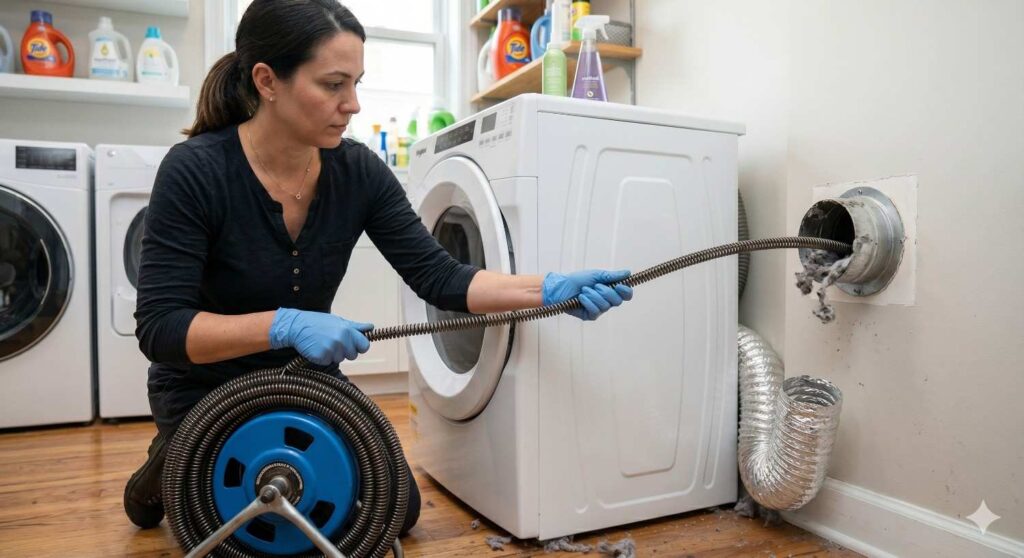
No, you should not use a plumbing snake to clean a dryer vent. A plumbing snake is engineered for breaking up blockages inside water pipes, not for removing lint from a 4-inch dryer duct — and using one risks puncturing the duct lining, compacting lint deeper into the vent, and creating a more serious fire hazard than the one you started with.
This matters because clogged dryer vents are one of the leading causes of residential house fires in the United States, making the choice of cleaning tool a genuine safety decision, not just a convenience question.
This guide explains exactly why a plumbing snake fails for dryer vents, which tools actually work, how to clean your dryer vent safely at home, and when to call a professional.
What Is a Plumbing Snake and How Does It Work?
A plumbing snake — also called a drain snake or hand auger — is a long, flexible metal cable with a corkscrew or auger tip at one end, designed to break apart or retrieve solid blockages inside drain pipes. The cable is fed into a pipe, rotated manually or with a drill, and the auger tip either bores through the clog or hooks onto it so it can be pulled back out.
Plumbing snakes are built for water-carrying pipes: kitchen drains, bathroom sinks, shower drains, and toilet lines. The auger tip is specifically shaped to grab, pierce, or break apart solid material — grease buildup, hair clogs, soap scum, and small foreign objects. That mechanical design is precisely what makes it the wrong tool for a dryer vent system.
Why a Plumbing Snake Is Not Safe for Dryer Vents
A dryer vent is not a drain pipe. It is a smooth-walled exhaust duct, typically 4 inches in diameter, designed to carry hot, moist air and loose lint from your dryer to the exterior of your home. The material inside is not a solid clog — it is a compressible, fibrous accumulation of lint that requires a brushing and suction approach, not a boring or hooking approach.
Using a plumbing snake in a dryer vent does not solve the problem. It creates new ones. Professional dryer vent cleaning technicians regularly encounter ducts that have been damaged or worsened by homeowners attempting to snake them, and the repairs are often more costly than the original cleaning would have been.
Risk 1: Damage to Duct Lining and Flexible Tubing
Most residential dryer vents include at least one section of flexible duct — either foil accordion-style tubing or semi-rigid aluminum. These materials are thin and designed for airflow, not for contact with a rotating metal auger tip. When a plumbing snake is inserted and rotated, the auger tip can easily puncture foil duct, tear the inner lining of flexible vinyl duct, or create small holes in semi-rigid aluminum sections.
Even a small puncture in a dryer vent duct is a serious problem. Hot, lint-laden air escaping through a hole in the duct can accumulate inside wall cavities, creating a hidden fire risk that is far harder to detect and address than a simple lint blockage.
Risk 2: Compacting Lint Instead of Removing It
Lint is soft and compressible. When a plumbing snake is pushed into a lint-clogged dryer vent, the auger tip does not grab the lint and pull it out — it pushes it forward and compresses it. The rotating motion can pack loose lint into a denser, harder mass that is more difficult to remove than the original accumulation.
This is the opposite of what you need. A properly designed dryer vent brush kit uses flexible bristles that sweep lint loose from the duct walls and allow it to be pulled back toward the dryer opening or expelled out the exterior vent — not pushed deeper into the system. <!–NEW PAGE NEEDED–>
Risk 3: No Lint Capture, Just Redistribution
Even if a plumbing snake manages to dislodge some lint without compacting it, the tool has no mechanism for capturing or removing that lint from the duct. The dislodged material simply falls back into the duct or gets pushed toward the exterior vent opening, where it can re-accumulate at the vent cap or flap. Effective dryer vent cleaning requires both dislodging lint from duct walls and removing it from the system entirely — typically through a combination of brushing and vacuuming.
What Tools Are Actually Designed to Clean Dryer Vents?
The right tools for dryer vent cleaning are purpose-built for the job: flexible enough to navigate bends in the duct, sized correctly for a 4-inch vent diameter, and designed to sweep lint loose rather than compact or pierce it.
Dryer Vent Brush Kits
A dryer vent brush kit is the most common and accessible DIY cleaning tool. These kits include a round brush head — typically 4 inches in diameter to match standard vent sizing — attached to a series of flexible, interlocking extension rods. You connect as many rods as needed to reach the full length of your vent run, insert the brush from the dryer end or the exterior vent opening, and work it back and forth to sweep lint off the duct walls.
Most kits include 6 to 12 feet of extension rods, which is sufficient for shorter, straighter vent runs. For longer or more complex runs, additional rod sets are available. The brush head is designed to make full contact with the duct interior without applying the kind of force that would damage the lining.
Rotary Dryer Vent Cleaning Systems
Rotary cleaning systems attach to a standard power drill and spin the brush head at high speed as it moves through the duct. The spinning action is significantly more effective at dislodging compacted lint than manual brushing alone, making rotary systems the preferred choice for vents that have not been cleaned in several years or that show signs of heavy buildup.
These systems use the same flexible rod design as manual brush kits but add the mechanical advantage of rotation, which helps the brush maintain consistent contact with the duct walls around bends and elbows. Professional dryer vent technicians typically use commercial-grade rotary systems paired with high-powered vacuums for complete lint removal.
Leaf Blower or Shop Vac Method
For shorter, straighter vent runs, a leaf blower or shop vacuum can be used in combination with a brush kit to improve lint removal. After brushing the duct walls, a leaf blower inserted at the dryer end can force dislodged lint out through the exterior vent opening. Alternatively, a shop vac positioned at the exterior vent cap can create suction to pull loosened lint out of the system.
This method works best as a complement to brushing, not as a standalone cleaning approach. It is not effective against compacted lint and should not be used as a substitute for physical brushing of the duct walls.
How to Clean a Dryer Vent Safely at Home (Step-by-Step)
Learning how to clean a dryer vent step by step is straightforward when you have the right tools and follow a logical sequence. Before you begin, gather your dryer vent brush kit, a vacuum with a hose attachment, a screwdriver, and work gloves.
- Unplug the dryer. Disconnect the power cord from the wall outlet. If you have a gas dryer, turn off the gas supply valve before moving the unit.
- Pull the dryer away from the wall. Create enough clearance to access the vent hose connection at the back of the dryer.
- Disconnect the vent hose. Loosen the clamp or tape securing the flexible vent hose to the dryer’s exhaust port and to the wall duct opening. Set the hose aside.
- Vacuum the dryer exhaust port. Use your vacuum hose to remove any loose lint from the dryer’s exhaust opening before inserting the brush.
- Insert the brush into the wall duct. Feed the brush head into the wall duct opening and attach extension rods as needed. Work the brush back and forth with a gentle rotating motion to sweep lint from the duct walls.
- Clean from the exterior vent opening. Go outside and remove the exterior vent cap. Insert the brush from the outside end and repeat the sweeping motion to dislodge any lint near the exterior opening.
- Vacuum the duct opening and surrounding area. Use the vacuum to collect all dislodged lint from both the interior wall opening and the exterior vent area.
- Inspect and clean the flexible vent hose. Check the disconnected hose for lint buildup, damage, or kinks. Clean it with the brush or vacuum, and replace it if it shows signs of wear or crushing.
- Reconnect everything. Reattach the vent hose to both the dryer exhaust port and the wall duct opening. Secure with clamps or foil tape. Replace the exterior vent cap.
- Run a test cycle. Plug the dryer back in, run a short cycle, and go outside to confirm that air is flowing freely from the exterior vent opening.
Signs Your Dryer Vent Is Clogged and Needs Cleaning
Recognizing the signs of a clogged dryer vent early can prevent both appliance damage and fire risk. The most common indicators fall into three categories: performance changes, safety signals, and physical observations. <!–NEW PAGE NEEDED–>
Performance signs:
- Clothes take two or more cycles to dry completely
- The dryer runs hotter than usual or shuts off mid-cycle
- Laundry feels unusually hot or damp at the end of a cycle
- Drying times have gradually increased over several months
Safety signals:
- A burning smell during or after a dryer cycle
- The exterior of the dryer feels very hot to the touch
- The laundry room feels warmer or more humid than normal
- The exterior vent flap does not open during operation
Physical observations:
- Visible lint accumulation around the dryer exhaust port
- Lint or debris visible around the exterior vent opening
- The flexible vent hose appears kinked, crushed, or disconnected
According to the U.S. Fire Administration, dryers and washing machines cause an estimated 2,900 residential fires each year, with failure to clean the dryer vent cited as the leading contributing factor. If you notice any of the signs above, cleaning the vent should be treated as an urgent maintenance task, not a deferred one.
How Often Should You Clean Your Dryer Vent?
The general recommendation from appliance manufacturers and fire safety organizations is to clean your dryer vent at least once per year. For most households with average laundry volume, annual cleaning is sufficient to prevent dangerous lint accumulation.
Several factors increase how often how often to clean a dryer vent should be addressed: <!–NEW PAGE NEEDED–>
- Large households doing five or more loads per week should clean every six months
- Homes with pets experience faster lint buildup due to pet hair mixing with fabric fibers
- Long vent runs (over 15 feet) or vents with multiple 90-degree bends accumulate lint more quickly and may need more frequent attention
- Older flexible duct with accordion-style ridges traps lint more aggressively than smooth-walled rigid duct
If you are unsure of the last time your dryer vent was cleaned, or if you have recently moved into a home, treat it as overdue and schedule a cleaning immediately.
When DIY Dryer Vent Cleaning Isn’t Enough
DIY cleaning with a brush kit works well for straightforward vent runs — short, mostly straight ducts with easy access at both ends. But many residential dryer vent systems are more complex than that, and those situations call for professional equipment and expertise.
Consider professional service when:
- Your vent run exceeds 25 feet or includes more than two 90-degree elbows, making it difficult to reach the full length with standard extension rods
- You cannot locate or access the exterior vent opening, which is common in multi-story homes or units where the vent exits through the roof
- You suspect duct damage — punctures, disconnected sections, or collapsed flexible tubing — that requires inspection before cleaning
- Your dryer still performs poorly after a DIY cleaning, which may indicate a deeper blockage or a duct configuration problem
- You have not cleaned the vent in more than two years, in which case compacted lint may require commercial-grade rotary equipment and vacuum extraction to remove safely
Professional technicians use high-powered rotary brush systems, commercial vacuums, and in some cases inspection cameras to verify that the duct is fully clear and structurally intact after cleaning. This level of thoroughness is not achievable with consumer-grade tools alone.
If you are in the Northern Virginia area, a dryer vent cleaning service in Alexandria, VA from AirDuctVet Dryer & Vent Cleaning Services provides a complete inspection, professional cleaning, and post-service verification — so you know the job is done right. <!–NEW PAGE NEEDED–>
Conclusion
A plumbing snake is the wrong tool for a dryer vent — its auger tip damages duct liners, compacts lint rather than removing it, and leaves your vent more hazardous than before. The right approach uses purpose-built brush kits, rotary cleaning systems, and proper vacuuming technique to fully clear the duct.
Recognizing clogged vent signs early and cleaning annually protects your dryer’s efficiency, reduces energy costs, and eliminates one of the most preventable causes of residential house fires.
For complex vent runs, suspected duct damage, or vents overdue for professional attention, contact AirDuctVet Dryer & Vent Cleaning Services — Alexandria, VA’s trusted choice for thorough, transparent dryer vent cleaning that gives you complete peace of mind.
Frequently Asked Questions
Can a plumbing snake damage a dryer vent?
Yes. A plumbing snake’s rotating auger tip can puncture flexible foil duct, tear semi-rigid aluminum lining, and compact lint deeper into the vent rather than removing it. This can worsen blockages and create hidden fire hazards inside wall cavities.
What is the best tool to clean a dryer vent?
A dryer vent brush kit with flexible extension rods is the most effective DIY tool. For heavy buildup, a rotary cleaning system attached to a power drill provides more thorough lint removal. Both should be paired with a vacuum to extract dislodged lint from the duct.
How do I know if my dryer vent is clogged?
The most common signs include clothes taking longer than one cycle to dry, a burning smell during operation, the dryer or laundry room feeling unusually hot, and the exterior vent flap not opening during a cycle. Any of these signals warrants immediate cleaning.
Can I clean my dryer vent myself?
Yes, for most standard vent runs. A dryer vent brush kit, a vacuum, and basic tools are sufficient for vents under 25 feet with straightforward routing. Longer runs, roof exits, or suspected duct damage are better handled by a professional service.
How often should a dryer vent be cleaned?
Most households should clean their dryer vent once per year. Homes with heavy laundry use, pets, or long vent runs may need cleaning every six months. If you are unsure when it was last cleaned, treat it as overdue and schedule a cleaning promptly.
What happens if you never clean your dryer vent?
Lint accumulates until airflow is severely restricted, forcing the dryer to overheat and run longer cycles. This increases energy costs, shortens the dryer’s lifespan, and significantly raises the risk of a dryer vent fire — one of the most common and preventable causes of residential house fires.
Is it worth hiring a professional to clean a dryer vent?
For complex vent systems, vents not cleaned in over two years, or situations where DIY cleaning has not resolved performance issues, professional cleaning is worth the cost. Professionals use commercial-grade rotary equipment and vacuums that achieve a level of thoroughness consumer tools cannot match.
