
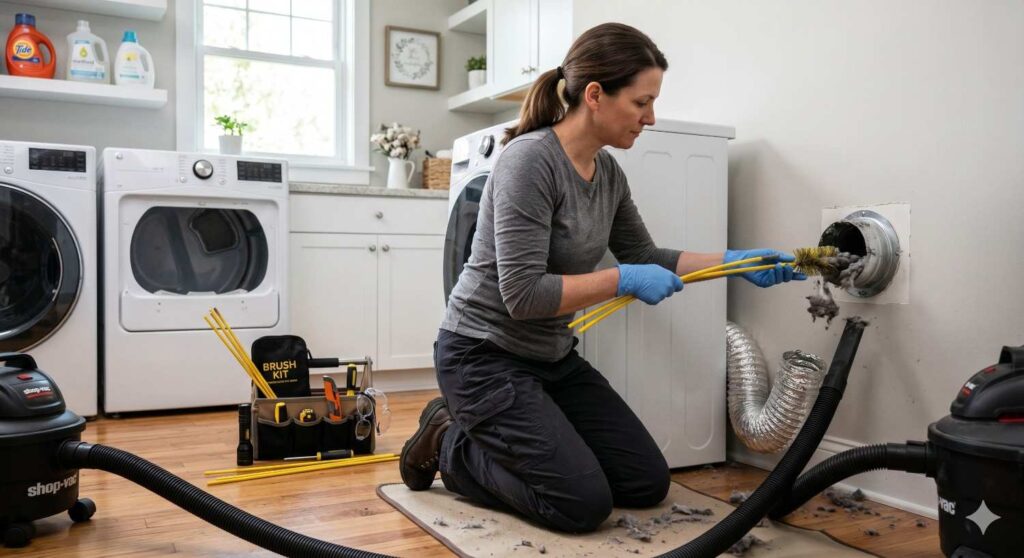
Yes, you can clean your dryer vent yourself — and for straightforward, accessible duct runs, a basic DIY cleaning every 12 months is a reasonable maintenance task most homeowners can handle with the right brush kit and about an hour of time.
That said, knowing what DIY cleaning actually accomplishes, where its limits are, and when lint buildup has progressed beyond a brush-and-vacuum job can save you from a fire hazard hiding inside your walls.
This guide walks you through every step of the process — from the tools you need and the exact cleaning technique to the warning signs that tell you it is time to stop and call a certified professional in Alexandria, VA.
What Is a Dryer Vent and Why Does It Need Cleaning?
Your dryer vent is the exhaust system that carries hot, moist air and lint particles from your dryer drum to the outside of your home. It is not the same as the lint trap inside your dryer door. The lint trap catches the largest particles, but fine lint fibers pass through it with every load and accumulate inside the duct over time.
Without regular cleaning, that accumulation restricts airflow, forces your dryer to work harder, extends drying times, and — most critically — creates a fire risk. According to the U.S. Fire Administration, dryers and washing machines cause an estimated 2,900 home fires each year, with failure to clean the dryer vent identified as the leading contributing factor.
How a Dryer Vent System Works
A dryer vent system consists of several connected components: the dryer exhaust port at the back of the appliance, a flexible or rigid transition duct that connects the dryer to the wall, rigid metal ductwork running through the wall or floor cavity, and an exterior vent cap that allows exhaust to exit the building while blocking pests and backdrafts.
Every time your dryer runs, it pushes heated air through this pathway. That air carries moisture and microscopic lint fibers. The fibers cling to the interior walls of the duct, and over months and years, they build into a dense, flammable layer that progressively narrows the duct opening.
Rigid metal ductwork — either galvanized steel or aluminum — is the industry-preferred material because its smooth interior surface resists lint adhesion better than flexible foil or plastic accordion-style hose. If your home still uses flexible plastic duct, that is a separate safety concern worth addressing regardless of how recently you cleaned it.
What Happens When Lint Builds Up in Your Dryer Vent
Restricted airflow from lint buildup creates a chain of problems that escalate in severity the longer the blockage goes unaddressed. In the early stages, you will notice your dryer taking longer than one cycle to fully dry a load. Clothes may feel hotter than usual when you remove them, and the exterior of the dryer itself may be warm to the touch.
As the restriction worsens, the dryer’s thermal limiter — a safety component designed to prevent overheating — begins tripping more frequently. This shortens the appliance’s lifespan and increases repair costs. At the extreme end, lint ignites. Lint is highly combustible, and the combination of heat, restricted airflow, and accumulated fuel inside a duct creates exactly the conditions that cause dryer fires.
Can You Really Clean a Dryer Vent Yourself?
The honest answer is: it depends on your specific duct configuration. DIY dryer vent cleaning works well for short, straight duct runs — typically those under 25 feet with no more than one or two 90-degree elbows. If your dryer is on an exterior wall and the vent exits directly behind or beside the appliance, a standard brush kit will reach the full length of the duct without difficulty.
Longer runs, multiple bends, vertical duct paths that travel up through the roof, or ducts that have not been cleaned in several years present a different challenge. In those situations, DIY tools often cannot reach the full duct length, cannot navigate tight bends without losing brush contact with the duct walls, and cannot dislodge compacted lint that has hardened over time.
What DIY Dryer Vent Cleaning Can and Cannot Do
A DIY cleaning with a quality brush kit can effectively remove loose lint from accessible duct sections, clear the transition hose between the dryer and the wall, clean the exterior vent cap and its flaps, and restore adequate airflow in simple duct configurations.
What it cannot reliably do is clean the full length of a long or complex duct run, remove compacted lint that has adhered firmly to duct walls, identify damage or disconnections inside the duct, or verify that the duct is fully clear using airflow measurement tools. Professional technicians use rotary brush systems, high-powered vacuums, and in some cases video inspection cameras to confirm a complete clean — capabilities that are not available in consumer-grade kits.
When DIY Is Appropriate vs. When It Is Not
DIY cleaning is appropriate when your duct run is short and straight, when you are performing routine annual maintenance rather than addressing a known blockage, and when your dryer has been showing only mild performance decline rather than significant warning signs.
DIY is not appropriate when your dryer is taking two or more cycles to dry a single load, when you can see or smell burning, when the exterior vent cap shows no airflow during operation, when your duct runs vertically through the roof, or when the duct has not been professionally cleaned in more than three years. In those cases, starting with a brush kit risks pushing compacted lint deeper into the duct or missing the blockage entirely.
Tools and Materials You Need to Clean a Dryer Vent Yourself
Having the right equipment before you start makes the difference between a thorough cleaning and a partial one. Attempting this job with improvised tools — a broom handle, a vacuum hose extension, or a makeshift brush — typically results in lint being pushed further into the duct rather than removed.
Basic DIY Dryer Vent Cleaning Kit Components
A standard dryer vent cleaning kit includes a flexible rod system with multiple connecting segments, a lint brush head sized for standard 4-inch dryer duct, and a drill attachment that allows the brush to spin as it moves through the duct. Kits from brands like Deflecto, Holikme, and Gardus LintEater are widely available at home improvement stores and online retailers for between $25 and $50.
In addition to the brush kit, you will need a vacuum cleaner with a hose attachment — ideally a shop vac with strong suction — to collect lint as it is dislodged. A screwdriver for removing the vent cap and disconnecting the transition hose, a flashlight or headlamp for inspecting the duct opening, and work gloves to protect your hands from sharp duct edges round out the basic toolkit.
Optional Tools That Improve DIY Cleaning Results
A cordless drill makes spinning the brush through the duct significantly more effective than rotating it by hand. Most brush kits are designed to connect to a standard drill chuck. If you have a long duct run, purchasing additional rod extension segments beyond what comes in the kit allows you to reach further into the duct.
A leaf blower used at the exterior vent opening after brushing can help push dislodged lint out through the dryer end — though this works best when someone is simultaneously vacuuming at the dryer connection point. An anemometer, a small handheld airflow meter, can be used at the exterior vent cap to verify that airflow has been restored after cleaning, giving you a measurable confirmation that the duct is clear.
How to Clean Your Dryer Vent Step by Step
Before you begin, confirm that your dryer is unplugged from the electrical outlet. If you have a gas dryer, turn off the gas supply valve. Clear the area around the dryer to give yourself working room, and lay down a drop cloth or old towel to catch lint that falls during the process.
Step 1 — Disconnect and Prepare Your Dryer
Pull the dryer away from the wall carefully to avoid damaging the flooring. You need enough clearance to access the exhaust port at the back of the appliance and the transition duct connection. Loosen the clamp or tape securing the transition duct to the dryer’s exhaust port and gently pull the duct free. Set the transition duct aside — you will clean it separately.
Use your flashlight to look into the dryer’s exhaust port. You will likely see lint accumulation immediately. Use your vacuum hose to remove as much of this lint as possible before inserting the brush. This prevents loose lint from being pushed further into the duct when you begin brushing.
Step 2 — Locate and Access the Exterior Vent Cap
Go outside and locate your dryer’s exterior vent cap. It is typically a louvered or flap-style cover mounted on an exterior wall, usually within a few feet of where your dryer sits inside. Remove any screws securing the cap and pull it free from the wall opening. Clean the cap itself — the flaps and housing accumulate lint and can become stuck in a partially closed position, which restricts airflow even when the duct is otherwise clear.
If the flaps on your exterior vent cap do not open and close freely, or if the cap is made of plastic and has become brittle or cracked, replace it. A damaged vent cap allows pests to enter the duct and reduces the efficiency of the exhaust system.
Step 3 — Use a Dryer Vent Brush Kit to Remove Lint
Connect the brush head to the first rod segment and insert it into the duct from the dryer end. Attach your drill to the rod end and set it to a low speed. As the brush spins, push it slowly forward into the duct, adding rod segments as needed to extend your reach. The spinning action scrubs lint from the duct walls and moves it toward the exterior opening.
Work in a slow, controlled forward-and-back motion rather than simply pushing the brush straight through. This scrubbing action is what dislodges lint that has adhered to the duct walls rather than simply pushing loose debris ahead of the brush. Have a helper hold the vacuum hose at the exterior vent opening to capture lint as it exits, or position the vacuum at the dryer end to collect debris as you work.
Step 4 — Vacuum the Duct Interior and Transition Hose
After brushing the full length of the duct, use your vacuum with the hose attachment to clean both ends of the duct opening — the dryer-side wall opening and the exterior vent opening. Remove as much residual lint as possible before reassembling.
Take the transition hose you removed in Step 1 and inspect it carefully. If it is a flexible foil or plastic accordion-style hose, check for tears, kinks, or crushing. These hoses are a common site of lint accumulation because their ridged interior surface traps fibers. Vacuum the interior of the transition hose thoroughly. If the hose is damaged or is made of plastic, replace it with a rigid or semi-rigid aluminum transition duct, which is the current recommended standard.
Step 5 — Reassemble, Reconnect, and Test
Reattach the exterior vent cap securely. Reconnect the transition hose to the dryer’s exhaust port and secure it with a clamp — not tape, which deteriorates over time. Push the dryer back into position, ensuring the transition hose is not kinked or crushed behind the appliance.
Restore power and, if applicable, gas supply. Run the dryer on a heat cycle for 15 to 20 minutes and go outside to confirm that warm air is flowing freely from the exterior vent cap. The flaps should open fully and you should feel a strong, consistent airflow. If airflow feels weak or the flaps barely move, the duct may still be partially blocked and warrants a professional inspection.
How to Tell If Your Dryer Vent Is Fully Clear After DIY Cleaning
A successful DIY cleaning should produce a noticeable improvement in dryer performance within the first one or two loads after cleaning. Drying times should return to the manufacturer’s standard — typically 30 to 45 minutes for a normal load. The exterior of the dryer should not feel excessively hot, and the laundry room should not feel noticeably more humid than usual during operation.
Signs Your Dryer Vent Still Has a Blockage
If any of the following conditions persist after your DIY cleaning, the duct is not fully clear and requires professional attention. Clothes are still damp after a full cycle. The dryer exterior or the top of the appliance feels very hot to the touch. You detect a burning smell during operation — this is a serious warning sign that should prompt you to stop using the dryer immediately. The exterior vent cap flaps are not opening fully or airflow at the exterior feels weak. The laundry room feels unusually warm or humid while the dryer runs.
These signs indicate either that the blockage is beyond the reach of your brush kit, that compacted lint remains adhered to the duct walls, or that there is a disconnection or damage somewhere in the duct run that is allowing exhaust to vent into the wall cavity rather than to the exterior.
How Often Should You Clean Your Dryer Vent?
The general industry recommendation, supported by the U.S. Consumer Product Safety Commission, is to clean your dryer vent at least once per year. For most households with a standard duct configuration and average laundry volume, annual cleaning is sufficient to prevent dangerous lint accumulation.
However, annual cleaning is a baseline, not a universal rule. Your actual cleaning frequency should be based on how quickly lint accumulates in your specific system, which varies considerably depending on several household factors.
Factors That Increase How Often You Need Dryer Vent Cleaning
Households that do more laundry than average — families with children, homes with multiple occupants, or properties where work clothing or athletic wear is laundered frequently — accumulate lint faster and may need cleaning every six months. Pet owners whose animals shed heavily will find that pet hair significantly accelerates lint buildup in both the lint trap and the duct.
Longer duct runs accumulate lint faster than short ones because lint has more surface area to cling to before exiting the system. Ducts with multiple bends create turbulence that deposits lint at the elbow joints. If your dryer uses a flexible foil transition hose rather than rigid metal duct, lint accumulates faster due to the ridged interior surface.
Landlords and property managers overseeing multi-unit buildings or rental properties should schedule dryer vent cleaning between tenancies as a standard practice, since tenant laundry habits vary widely and duct conditions are not always visible or reported until a problem develops.
When to Call a Professional Dryer Vent Cleaning Service
There is a clear point at which continuing to DIY your dryer vent cleaning stops being cost-effective and starts being a safety risk. Recognizing that point is as important as knowing how to perform the cleaning itself.
Warning Signs That Require Professional Dryer Vent Cleaning
Call a professional dryer vent cleaning service when your dryer is taking significantly longer than one cycle to dry a load, when you smell burning during operation, when the dryer shuts off mid-cycle due to overheating, when your duct has not been professionally cleaned in more than three years, or when your duct runs vertically through the roof rather than horizontally through an exterior wall.
Roof-exit duct configurations are particularly challenging for DIY cleaning because the brush must travel vertically, gravity works against lint removal, and the exterior termination point — a roof cap — is not safely accessible to most homeowners. Professional technicians have the equipment and training to clean these configurations safely and completely.
If you have recently moved into a home and do not know the cleaning history of the dryer vent, scheduling a professional inspection and cleaning before relying on DIY maintenance is a sound starting point. You cannot effectively maintain a system whose baseline condition you do not know.
What a Professional Dryer Vent Cleaning Service Includes
A professional dryer vent cleaning service from a qualified contractor includes a full inspection of the duct run from the dryer connection to the exterior termination point, cleaning using commercial-grade rotary brush equipment and high-powered vacuum extraction, inspection and cleaning of the exterior vent cap, and a post-cleaning airflow verification to confirm the duct is fully clear.
Reputable contractors will also identify and report any duct damage, disconnections, improper materials — such as plastic flexible duct — or code compliance issues observed during the cleaning. This inspection component is something DIY cleaning cannot replicate, and it is one of the primary reasons professional cleaning delivers more comprehensive results than even a thorough DIY effort.
How Much Does Professional Dryer Vent Cleaning Cost in Alexandria, VA?
Professional dryer vent cleaning in Alexandria, VA typically costs between $89 and $175 for a standard residential service. The variation in price reflects differences in duct length, duct configuration complexity, the condition of the duct at the time of service, and whether the exterior vent cap requires replacement.
This price range is for dryer vent cleaning as a standalone service. Many homeowners in Alexandria combine dryer vent cleaning with air duct cleaning or HVAC maintenance during the same service visit, which can reduce the per-service cost compared to scheduling each service separately.
What Affects the Price of Dryer Vent Cleaning?
Several factors influence where your specific service falls within the typical price range. Duct length is the primary driver — longer ducts require more time and more equipment to clean thoroughly. Duct configuration matters as well: a straight horizontal run to an exterior wall is faster to clean than a duct with multiple elbows or a vertical run to a roof cap.
The condition of the duct at the time of service affects cost because heavily compacted lint or a duct that has not been cleaned in many years requires more time and effort to restore to a clear condition. If the exterior vent cap needs replacement, that is typically an additional charge of $15 to $40 depending on the cap style. Accessibility also plays a role — ducts that require moving appliances, accessing crawl spaces, or working at roof level involve additional labor.
DIY vs. Professional Dryer Vent Cleaning — Cost Comparison
| Factor | DIY Cleaning | Professional Service |
| Upfront cost | $25 to $50 (kit) | $89 to $175 |
| Time required | 1 to 2 hours | 45 to 90 minutes |
| Duct length coverage | Limited by kit length | Full duct run |
| Airflow verification | Visual/manual only | Measured confirmation |
| Damage identification | Not possible | Included |
| Suitable for complex ducts | No | Yes |
| Frequency needed | Annually (simple ducts) | Every 1 to 3 years |
For homeowners with simple, short duct configurations, DIY cleaning is a cost-effective annual maintenance task. For those with longer or more complex systems, the professional service cost is justified by the completeness of the cleaning and the inspection value it provides. Over a three-year period, the cost difference between annual DIY cleaning and biennial professional cleaning is often smaller than it appears when comparing single-service prices.
Dryer Vent Cleaning Safety: Fire Hazards and Code Compliance
Dryer vent cleaning is not purely a maintenance task — it is a fire prevention measure. The National Fire Protection Association (NFPA) addresses dryer installation and maintenance standards in NFPA 211, which covers chimney, fireplace, venting system, and solid fuel burning appliance standards, and in manufacturer installation guidelines that are incorporated into local building codes.
The core safety principle is straightforward: a dryer vent must exhaust to the exterior of the building, must be constructed of approved materials, must not exceed the maximum allowable duct length for the appliance, and must be kept clear of lint accumulation. Violations of any of these conditions create fire risk and, in some jurisdictions, code compliance liability for property owners.
Alexandria, VA Dryer Vent Safety Standards Homeowners Should Know
In Alexandria, VA, residential dryer vent installations are governed by the Virginia Uniform Statewide Building Code, which adopts the International Mechanical Code (IMC) as its basis for mechanical system requirements. Under these standards, dryer exhaust ducts must be constructed of rigid metal or semi-rigid metal — not plastic flexible duct — must terminate at the exterior of the building, and must not be connected to any other duct, vent, or chimney system.
The IMC specifies a maximum duct length of 35 feet for a standard dryer exhaust duct, with length reductions required for each elbow in the run. A 90-degree elbow reduces the allowable duct length by 5 feet; a 45-degree elbow reduces it by 2.5 feet. If your duct run exceeds these limits, a booster fan may be required to maintain adequate airflow — and that booster fan itself requires periodic maintenance.
For landlords and property managers in Alexandria, maintaining dryer vent systems in rental properties is part of the habitability standard. A dryer vent that poses a fire hazard due to neglected maintenance is a liability issue, not just a maintenance inconvenience. Scheduling professional dryer vent cleaning as part of a routine property maintenance program is both a safety practice and a risk management measure.
Conclusion
Cleaning your dryer vent yourself is a practical, achievable task for most homeowners with simple duct configurations — and doing it annually is one of the most effective fire prevention steps you can take for your home. Understanding the limits of DIY cleaning, recognizing the warning signs that indicate a more serious blockage, and knowing when professional service is the right call gives you the full picture you need to keep your dryer system safe and efficient.
At AirDuctVet Dryer and Vent Cleaning Services, we work with homeowners, landlords, and property managers throughout Alexandria, VA to provide thorough, transparent dryer vent cleaning with honest pricing and no unnecessary upsells. Whether you need a professional cleaning after a DIY attempt that did not fully resolve the problem, or you want a certified technician to handle the job from the start, we bring the equipment and expertise to get it done right.
Contact AirDuctVet Dryer and Vent Cleaning Services today to schedule your dryer vent inspection and cleaning in Alexandria, VA. We will give you a clear assessment of your duct condition, a straightforward price, and the confidence that your dryer is operating safely.f
Frequently Asked Questions
How long does it take to clean a dryer vent yourself?
A DIY dryer vent cleaning typically takes between one and two hours for a straightforward duct run. This includes disconnecting the dryer, brushing the full duct length, vacuuming both ends, cleaning the exterior vent cap, and reassembling the system.
Can a clogged dryer vent cause a house fire?
Yes. Lint is highly combustible, and a clogged dryer vent traps heat and restricts airflow, creating conditions that can ignite accumulated lint inside the duct. The U.S. Fire Administration identifies failure to clean the dryer vent as the leading cause of dryer fires in residential buildings.
What is the best dryer vent cleaning kit for DIY use?
Brush kits with flexible connecting rod segments and a drill-compatible attachment — such as those from Deflecto, Holikme, or Gardus LintEater — are the most effective consumer-grade options. Look for a kit that includes enough rod segments to reach the full length of your duct run.
How do I know if my dryer vent is clogged?
The most common signs of a clogged dryer vent include clothes taking more than one cycle to dry fully, the dryer exterior feeling excessively hot during operation, a burning smell during use, and weak or no airflow at the exterior vent cap. Any of these signs warrants immediate attention.
Is it safe to use a leaf blower to clean a dryer vent?
A leaf blower can help push dislodged lint out of the duct after brushing, but it should not be used as a substitute for brushing. Blowing air through a heavily clogged duct without first loosening the lint can compact the blockage further rather than clearing it.
How much does dryer vent cleaning cost in Alexandria, VA?
Professional dryer vent cleaning in Alexandria, VA typically costs between $89 and $175 for a standard residential service. The final price depends on duct length, configuration complexity, the condition of the duct, and whether the exterior vent cap requires replacement.
Does cleaning the dryer vent improve dryer performance?
Yes, significantly. A clear dryer vent restores proper airflow, which allows the dryer to exhaust heat and moisture efficiently. Most homeowners notice that drying times return to the manufacturer’s standard — typically 30 to 45 minutes per load — immediately after a thorough cleaning.
