
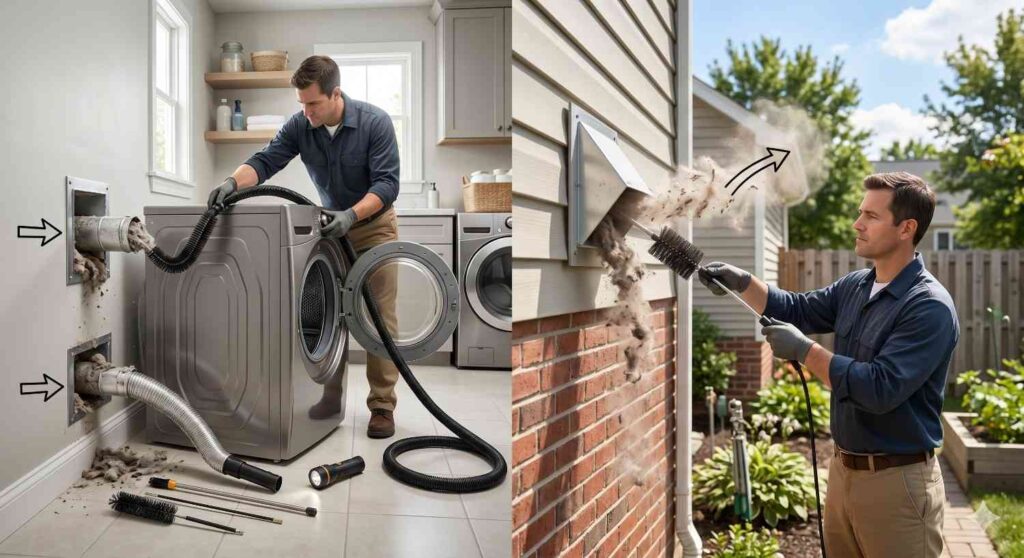
You should clean a dryer vent from both the inside and the outside — not just one end. Cleaning from only one direction leaves lint compacted in the middle of the duct run, restricting airflow and creating a serious fire hazard that most homeowners in Alexandria, VA never realize exists.
Knowing which end to start from, what tools to use, and when the duct is too long or too complex for a DIY brush kit can save you from a house fire, a broken dryer, or an expensive service call.
This guide covers the complete process: how to clean from the dryer side, how to clean from the exterior cap, and when to call a professional for a full dryer vent cleaning.
The Short Answer: You Need to Clean from Both Ends
Dryer vent cleaning requires access from both the interior connection point at the dryer and the exterior vent cap on the outside wall. Cleaning from only one end pushes lint deeper into the duct or compacts it against a bend, leaving a blockage that restricts airflow just as effectively as an uncleaned vent.
The interior access point is where the dryer’s flexible hose connects to the rigid duct inside the wall. The exterior access point is the vent cap or vent hood mounted on the outside of your home, where hot, moist air exits. Both openings must be cleared for the duct run to flow freely.
Why One-End Cleaning Leaves Lint Behind
Lint does not travel in a straight line through a dryer vent. It accumulates at bends, at the transition between flexible and rigid duct sections, and at any point where airflow slows. When you insert a brush from only one end and push, you are not removing lint — you are relocating it.
Pushing from the inside compacts debris toward the exterior cap, where it can block the louvers or flap. Pushing from the outside drives lint back toward the dryer connection, where it can re-enter the dryer cabinet. Neither approach clears the full duct run. Only working from both ends — loosening debris from each direction and vacuuming it out — achieves a complete removal.
What “Both Ends” Actually Means in Practice
The interior end is the point where your dryer’s exhaust hose connects to the wall duct, typically behind the dryer. The exterior end is the vent cap mounted on your home’s exterior wall, soffit, or roof. The duct run between these two points — which can range from 5 feet to over 35 feet depending on your home’s layout — is the section that must be fully cleared.
Cleaning both ends means disconnecting the dryer, inserting a brush from the interior opening, then going outside to remove the vent cap and inserting a brush from that direction as well. Vacuuming at both ends captures the loosened lint rather than leaving it inside the duct.
How to Clean a Dryer Vent from the Inside
Interior dryer vent cleaning starts at the dryer connection point and works outward through the duct run. This is typically the first step in a complete cleaning because it allows you to loosen and vacuum the heaviest lint accumulation near the dryer itself.
Tools You Need for Interior Dryer Vent Cleaning
Before starting, gather the following:
- Dryer vent brush kit with flexible rod extensions — the brush head attaches to interlocking rods that extend into the duct; most consumer kits reach 12 feet
- Shop vacuum with a hose attachment — captures loosened lint at the opening rather than letting it fall into the duct or laundry room
- Flathead or Phillips screwdriver — for loosening the hose clamp at the dryer connection
- Work gloves — lint and duct edges can be sharp
- Flashlight or headlamp — to inspect the duct opening before and after cleaning
- Foil tape or duct tape — to reseal any connections that come loose during the process
Step-by-Step: Cleaning the Vent from the Dryer Side
- Unplug the dryer from the electrical outlet. If you have a gas dryer, turn off the gas supply valve before moving the unit.
- Pull the dryer away from the wall to access the exhaust hose at the back.
- Loosen the hose clamp and disconnect the flexible exhaust hose from the wall duct opening.
- Insert the brush head into the wall duct opening and attach the first rod extension.
- Push the brush forward while rotating it clockwise, adding rod extensions as you go deeper into the duct.
- Pull the brush back slowly while continuing to rotate, drawing loosened lint toward the opening.
- Vacuum the opening with the shop vacuum to capture all debris before it falls back into the duct.
- Repeat the push-pull motion two to three times until the brush comes back clean.
- Reconnect the exhaust hose and tighten the clamp securely.
- Plug the dryer back in, run it on air-only for five minutes, and check that airflow is strong at the exterior cap.
How Far Can You Reach from the Inside?
Most consumer dryer vent brush kits extend to 12 feet when all rod sections are connected. The average residential dryer vent duct run in Alexandria, VA ranges from 15 to 35 feet, depending on where the dryer is located relative to the exterior wall. In townhouses — which are common throughout Alexandria — duct runs frequently exceed 20 feet and include one or more 90-degree bends.
This means a standard brush kit will not reach the full length of the duct from the interior alone. The section of duct beyond the brush’s reach remains uncleaned, which is why exterior cleaning is not optional — it is the only way to address the middle and far end of a longer duct run.
How to Clean a Dryer Vent from the Outside
Exterior dryer vent cleaning starts at the vent cap on the outside of your home and works inward through the duct. This step clears the debris that interior cleaning cannot reach and removes any blockages at the cap itself — which is one of the most common points of restriction in residential dryer vents.
Locating the Exterior Vent Cap in Alexandria Homes
In most Alexandria single-family homes and townhouses, the exterior dryer vent cap is mounted on a side wall, typically within a few feet of where the dryer sits on the interior. In older Alexandria homes and rowhouses, the cap may be located higher on the wall or in a soffit above the first floor if the duct runs upward before exiting.
In some configurations — particularly in multi-story townhouses in neighborhoods like Del Ray, Old Town, or Kingstowne — the vent may exit through the roof rather than a side wall, which significantly complicates exterior access. Look for a rectangular or round cap with a louvered flap or a hinged cover, usually 4 inches in diameter, on the exterior wall nearest to your laundry area.
Step-by-Step: Cleaning the Vent from the Exterior Cap
- Locate the exterior vent cap on the outside wall and inspect it visually for blockages, damaged louvers, or debris.
- Remove the cap by unscrewing the mounting screws or pulling it free from its friction-fit housing. Some caps have a single screw at the top; others have four corner screws.
- Inspect the duct opening with a flashlight for visible lint buildup, bird nests, or pest debris.
- Insert the brush head into the duct opening from the exterior and attach rod extensions.
- Push the brush inward while rotating clockwise, working through the duct toward the dryer connection.
- Pull the brush back slowly while rotating, drawing loosened lint toward the exterior opening.
- Vacuum the exterior opening to capture all debris.
- Repeat two to three times until the brush returns clean.
- Reinstall the vent cap securely, ensuring the louvers or flap open and close freely.
- Go inside and run the dryer on air-only for five minutes, then return outside to confirm the cap flap opens with airflow.
When the Outside Vent Cap Is Blocked or Damaged
The exterior vent cap is the most exposed part of the dryer vent system and the most likely point of blockage. Common problems include:
- Bird nests or pest debris — birds and small animals frequently build nests inside vent caps during spring and fall; this is especially common in Alexandria’s older neighborhoods with mature tree cover
- Crushed or stuck louvers — the flap mechanism can freeze shut in winter or warp from heat exposure, preventing exhaust air from escaping
- Missing or broken flap — a cap without a functioning flap allows cold air, moisture, and pests to enter the duct year-round
- Ice blockage — in cold winters, condensation inside the duct can freeze at the cap, sealing it completely
If the cap is damaged, cleaning alone will not solve the problem. A blocked or broken cap must be replaced before the vent system can function safely. Cap replacement is a straightforward repair, but it requires matching the correct cap type and diameter to your existing duct.
When DIY Dryer Vent Cleaning Is Not Enough
DIY cleaning with a consumer brush kit works well for short, straight duct runs with easy access at both ends. For many Alexandria homeowners, however, the duct configuration makes complete DIY cleaning difficult or impossible — and an incomplete cleaning can create a false sense of security while leaving a dangerous blockage in place.
Situations where DIY cleaning is insufficient include duct runs longer than 15 feet, ducts with multiple 90-degree bends, roof-exit vents that require ladder access, and vents with heavy lint buildup that a consumer brush cannot dislodge. In these cases, professional dryer vent cleaning in Alexandria <!–NEW PAGE NEEDED–> is the only way to ensure the full duct run is clear. For a detailed comparison of what each approach covers, see our guide on DIY vs. professional dryer vent cleaning <!–NEW PAGE NEEDED–>.
Signs Your Dryer Vent Needs Professional Cleaning
Watch for these warning signs that indicate a clog beyond what a DIY brush kit can address:
- Clothes take more than one cycle to dry — the most common and reliable indicator of restricted airflow
- The dryer exterior feels unusually hot during or after a cycle
- A burning smell during operation, which indicates lint is overheating inside the duct
- Excess lint accumulating around the dryer, on top of the unit, or in the laundry room
- The exterior vent flap does not open when the dryer is running
- The laundry room feels humid after a drying cycle, indicating exhaust is not escaping properly
- The dryer shuts off mid-cycle due to thermal overload protection triggering from heat buildup
If you notice any of these signs, stop using the dryer until the vent is inspected. Continuing to run a dryer with a severely restricted vent is one of the leading causes of residential dryer fires. For a complete breakdown of what each warning sign means, see our guide on signs your dryer vent is clogged <!–NEW PAGE NEEDED–>.
You may also want to consider air duct and dryer vent cleaning as part of a broader indoor air quality assessment if you are noticing dust or air quality issues throughout your home.
What Professional Dryer Vent Cleaning Includes
A professional dryer vent cleaning service goes significantly beyond what a consumer brush kit can accomplish. Professional technicians use rotary brush systems powered by electric drills, which spin at high speed and dislodge compacted lint that hand-rotated brushes cannot reach. These systems are paired with high-powered vacuums that create negative pressure inside the duct, pulling debris out rather than pushing it through.
A complete professional service includes a full inspection of the duct run from both ends, verification that the exterior cap opens and closes correctly, airflow measurement before and after cleaning to confirm the duct is clear, and a check of the dryer-to-wall connection for leaks or damage. Some services also include a duct inspection camera pass for longer or more complex duct runs.
Dryer Vent Cleaning Safety: Fire Risk and Code Compliance
Dryer vent cleaning is not just a maintenance task — it is a fire prevention measure. According to the U.S. Fire Administration, clothes dryers cause an estimated 2,900 home fires each year in the United States, resulting in approximately 5 deaths, 100 injuries, and $35 million in property damage annually. Failure to clean the dryer vent is the leading contributing factor in these fires.
Lint is highly flammable. When it accumulates inside a duct and the dryer’s exhaust temperature rises — which happens naturally when airflow is restricted — the lint can ignite. The fire then travels through the duct and into the wall cavity, where it can spread rapidly before any visible signs appear.
NFPA 211, the standard that governs venting systems in residential buildings, recommends annual inspection and cleaning of dryer vents. Many homeowner’s insurance policies also require evidence of regular dryer vent maintenance as a condition of coverage for dryer-related fire claims. Scheduling a professional dryer vent cleaning annually is the most reliable way to stay compliant and protected.
How Often Should You Clean Your Dryer Vent in Alexandria, VA?
For most Alexandria households, annual dryer vent cleaning is the minimum recommended frequency. However, several factors increase how often cleaning is needed:
- Large households (4+ people) running multiple loads per day should clean every 6 months
- Homes with long duct runs (over 20 feet) accumulate lint faster and need more frequent attention
- Pet owners whose laundry carries pet hair should clean every 6 months, as pet hair accelerates lint buildup significantly
- Townhouses in Alexandria — particularly those in Del Ray, Potomac Yard, and Kingstowne — often have longer duct runs due to the distance between interior laundry areas and exterior walls, making twice-yearly cleaning advisable
A simple test: if your dryer takes noticeably longer to dry a standard load than it did six months ago, the vent likely needs cleaning regardless of when it was last serviced. For a full breakdown of cleaning schedules by household type, see our guide on how often you should clean your dryer vent <!–NEW PAGE NEEDED–>. Pairing your dryer vent schedule with indoor air quality maintenance for your full HVAC system ensures your home’s air systems stay clean and efficient year-round.
Conclusion
Cleaning a dryer vent correctly means working from both the interior dryer connection and the exterior vent cap, using the right tools, and recognizing when the duct run is too long or complex for a consumer brush kit to handle completely.
For Alexandria homeowners — especially those in townhouses with longer duct configurations — the gap between what DIY cleaning reaches and what the full duct run requires is often significant, making professional service the safer and more reliable choice.
When you are ready for a thorough, verified dryer vent cleaning, contact AirDuctVet Dryer & Vent Cleaning Services — Alexandria’s trusted team for complete dryer vent and air duct cleaning that protects your home and your family.
Frequently Asked Questions
Can I clean my dryer vent myself, or do I need a professional?
You can clean a short, straight dryer vent yourself using a brush kit and shop vacuum. For duct runs longer than 15 feet or vents with multiple bends, professional cleaning is more effective and thorough.
How do I know if my dryer vent is clogged?
The most reliable sign is clothes taking more than one cycle to dry fully. Other indicators include a burning smell during operation, a hot dryer exterior, and the exterior vent flap not opening when the dryer runs.
What happens if you never clean your dryer vent?
Lint accumulates until airflow is severely restricted, causing the dryer to overheat. This significantly increases the risk of a dryer fire, reduces appliance lifespan, and raises energy costs from longer drying cycles.
How long does it take to clean a dryer vent?
A DIY cleaning of a short duct run typically takes 30 to 60 minutes. A professional cleaning, including inspection and airflow verification, generally takes 45 to 90 minutes depending on duct length and complexity.
Does dryer vent cleaning require special equipment?
Effective cleaning requires a flexible brush kit with rod extensions, a shop vacuum, and access to both ends of the duct. Professionals use powered rotary brush systems and high-powered vacuums that outperform consumer kits on longer or more congested duct runs.
How much does dryer vent cleaning cost in Alexandria, VA?
Dryer vent cleaning in Alexandria typically ranges from $89 to $175 for a standard residential duct run. Longer runs, roof exits, or heavy buildup may increase the cost. Visit our dryer vent cleaning pricing in Alexandria page for current rates and service details.
Can a clogged dryer vent cause a fire?
Yes. According to the U.S. Fire Administration, dryers cause approximately 2,900 home fires per year in the United States, with failure to clean the vent identified as the leading contributing factor. Lint is highly flammable and ignites when overheated by restricted airflow.

