
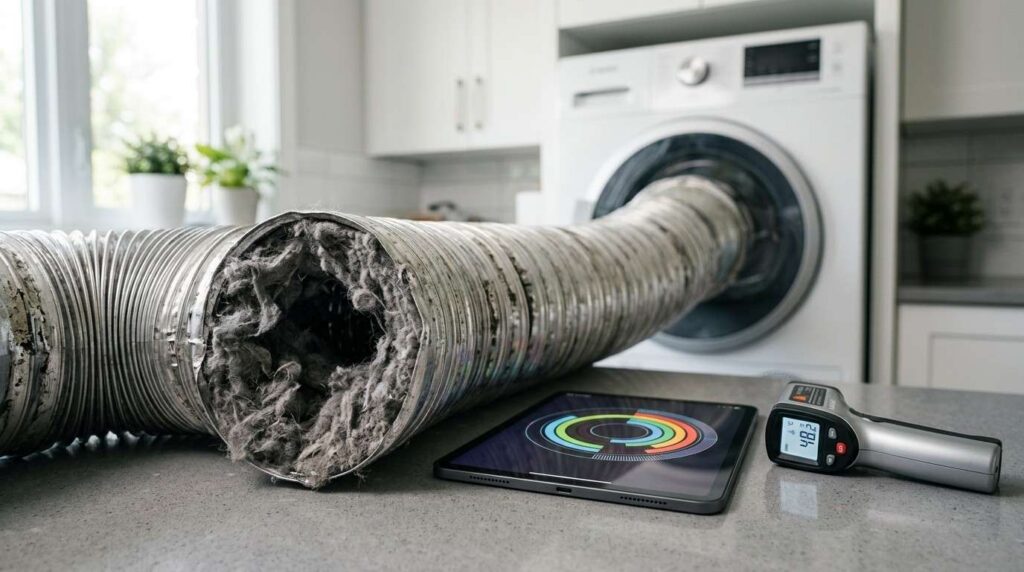
Roughly 32% of dryer-related house fires are caused by clogged dryer vents, according to the U.S. Fire Administration. Dryer fires account for about 2,900 residential fires every year in the United States, and failure to clean the vent is the single leading cause. For homeowners in Alexandria, VA, that statistic translates into a preventable risk hiding behind the laundry room wall, where lint quietly accumulates until heat and restricted airflow create ignition conditions.
The Direct Answer: Dryer Vent Fire Statistics
Clogged dryer vents cause approximately 32% of all dryer-related residential fires in the United States. The U.S. Fire Administration reports that dryer fires lead to an estimated $35 million in property loss, 100 injuries, and 5 deaths annually. Failure to clean is consistently the top contributing factor, ahead of mechanical and electrical failures.
What the NFPA and U.S. Fire Administration Data Shows
The National Fire Protection Association and U.S. Fire Administration track dryer fires as a distinct category because the cause pattern is so consistent. Across multi-year datasets, lint accumulation and blocked exhaust paths appear in roughly one out of every three incidents. Most fires start in the lint trap, vent duct, or behind the dryer, where heat has nowhere to escape. In residential homes, gas and electric dryers show similar failure patterns when vents are neglected.
Why Clogged Dryer Vents Are the Leading Failure Point
Dryer vents fail because lint is highly flammable and accumulates in places homeowners cannot see. Even with regular lint trap cleaning, particles travel deeper into the duct, narrowing airflow over time. Reduced airflow forces the dryer to run hotter and longer, which raises duct temperatures toward lint’s ignition point. Long, bent, or improperly terminated vent lines in Alexandria townhomes and condos accelerate this buildup because hot, moist air cannot exit efficiently.
Understanding the percentage is the starting point. How lint accumulates inside the vent line explains the mechanical chain reaction that turns ordinary laundry use into a measurable fire risk.
How Lint Buildup Turns a Dryer Vent Into a Fire Hazard
A dryer vent becomes dangerous when the exhaust pathway can no longer expel heat and moisture at the rate the dryer produces them. Lint coats the inside of the duct, the booster fan housing, and the exterior vent hood. As the layer thickens, airflow drops. The heating element cycles more aggressively. Internal duct temperatures climb. When surface temperature meets lint’s ignition threshold, a single spark from the motor or heating element is enough to start combustion. Older homes in Alexandria with longer vent runs through attics or crawlspaces are especially vulnerable because horizontal distance multiplies friction loss.
Warning Signs Alexandria Homeowners Should Never Ignore
Clothes that stay damp after a full cycle are the most reliable early indicator. Other red flags include a hot dryer exterior, a burning smell during operation, lint visible around the outdoor vent hood, and cycles that now take two or three rounds to finish. Recognizing the early signs of restricted airflow gives homeowners a window to act before damage occurs.
How Often Dryer Vents Should Be Cleaned to Prevent Fires
Professional cleaning once a year is the standard recommendation for single-family homes. Households with pets, large families, or vent runs longer than 25 feet should clean every six months. Rental properties and multi-unit buildings need scheduled inspections because tenants rarely report performance issues until cycles fail completely. A professional service inspects the full duct path, removes compacted lint, checks the exterior termination, and verifies airflow with calibrated instruments. Knowing typical dryer vent cleaning pricing helps property managers budget realistically without overpaying for unnecessary add-ons.
Conclusion
Clogged dryer vents drive roughly 32% of dryer-related house fires, making cleaning one of the highest-return safety investments a homeowner can make. For Alexandria homeowners, landlords, and property managers, a yearly inspection protects property, tenants, and insurance standing while extending dryer lifespan.
At AirDuctVet Dryer & Vent Cleaning Services, we deliver transparent inspections and professional vent cleaning that eliminates fire risk. Schedule your service today.
Frequently Asked Questions
How many house fires are caused by dryers each year?
U.S. fire departments respond to about 2,900 dryer-related home fires annually, causing roughly $35 million in property damage, 100 injuries, and 5 deaths each year.
Can a clogged dryer vent really start a fire?
Yes. Lint is highly combustible, and restricted airflow forces dryers to run hotter. When duct temperatures reach lint’s ignition point, combustion can occur within minutes.
How do I know if my dryer vent is a fire hazard?
Damp clothes after full cycles, a hot dryer exterior, burning smells, and visible lint around the outdoor vent hood all signal dangerous airflow restriction needing immediate attention.
Does cleaning the lint trap prevent dryer fires?
No. The lint trap captures only surface lint. Most accumulation builds deeper in the duct, requiring professional cleaning to fully eliminate fire risk.
How often should dryer vents be professionally cleaned?
Once a year for most homes. Households with pets, large families, or vent runs over 25 feet should schedule cleaning every six months.

