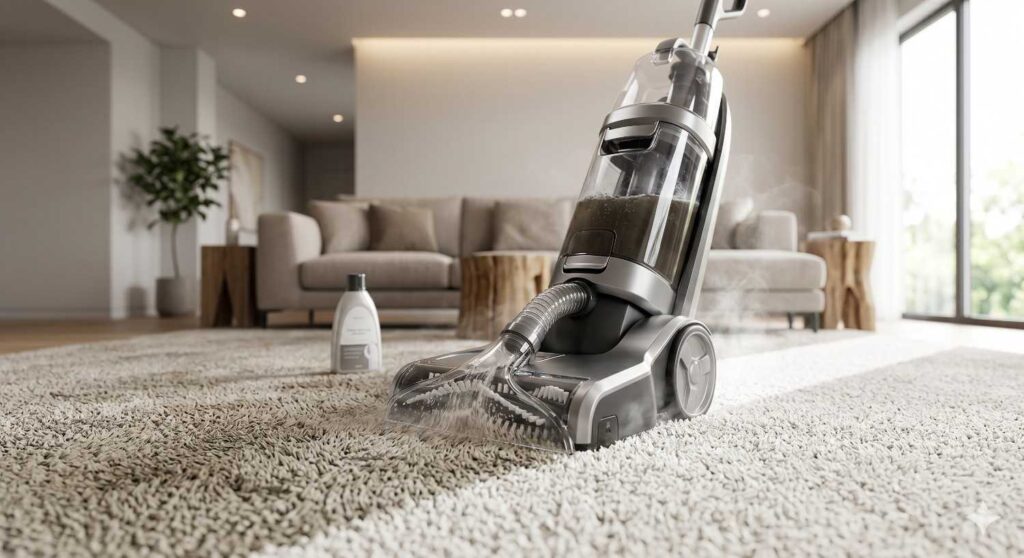
The Bissell ProHeat 2X Revolution MAX is consistently rated the highest home carpet cleaner in 2025, earning top marks across major retail platforms for its dual-tank heated cleaning system, powerful extraction, and CRI Platinum certification — making it the benchmark for residential deep cleaning performance.
Choosing the wrong machine means wet carpets, poor stain removal, and wasted money on a tool that underdelivers. For Alexandria homeowners dealing with pet hair, seasonal allergens, and high-traffic areas, the stakes are real.
This guide covers the top-rated home carpet cleaners, what separates the best from the rest, how to match a machine to your household, and why carpet cleaning is only one part of a truly clean home environment.
What Makes a Home Carpet Cleaner “Top-Rated”?
A home carpet cleaner earns a top rating when it consistently delivers strong extraction performance, fast drying times, and reliable results across carpet types — verified by independent testing and confirmed by thousands of consumer reviews. Ratings are not just about star counts. They reflect a machine’s ability to remove embedded dirt, pet dander, and stains without damaging carpet fibers or leaving excessive moisture behind.
Cleaning Power and Extraction Performance
Extraction performance is the single most important factor in carpet cleaner ratings. A machine’s ability to pull dirty water — along with dissolved soils, allergens, and bacteria — back out of the carpet determines how clean the result actually is. Machines with higher suction power and heated water systems consistently outperform cold-water models in independent testing. Heat loosens embedded soils and activates cleaning solutions more effectively, which is why heated carpet extractors dominate the top-rated category.
Look for machines rated above 12 amps for upright models. Portable spot cleaners operate at lower power but compensate with concentrated nozzle pressure. The combination of water temperature, brush agitation speed, and suction strength determines real-world cleaning results — not marketing claims.
Tank Capacity and Run Time
Tank capacity directly affects how much carpet you can clean before stopping to refill or empty. For a standard three-bedroom home, a clean water tank of at least 1 gallon (approximately 128 oz) allows continuous cleaning of most main living areas without interruption. Dirty water tanks should match or exceed clean water capacity to avoid mid-session stops.
Machines with separate clean and dirty water tanks — rather than a single combined reservoir — prevent redepositing soils back onto the carpet. This design feature appears in every top-rated model and is a non-negotiable attribute for serious home cleaning.
CRI Certification and Independent Testing Standards
The Carpet and Rug Institute (CRI) operates the Seal of Approval testing program, which independently evaluates carpet cleaning machines for soil removal, water removal, and carpet appearance retention. Machines earning CRI Gold or Platinum certification have passed rigorous third-party testing — not just manufacturer claims.
When comparing carpet cleaners, CRI certification is the most reliable independent quality signal available. The Bissell ProHeat 2X Revolution MAX and several Hoover models carry CRI Platinum ratings, which is a primary reason they dominate top-rated lists across Consumer Reports, Wirecutter, and major retail platforms.
The Highest Rated Home Carpet Cleaners in 2025
The following machines represent the top-rated options based on aggregated consumer ratings, independent testing results, CRI certification status, and verified performance across household use cases.
Bissell ProHeat 2X Revolution MAX — Best Overall
The Bissell ProHeat 2X Revolution MAX holds the top position in nearly every major 2025 carpet cleaner ranking. It combines a heated cleaning system, dual DirtLifter PowerBrushes, and a 1-gallon clean water tank with CRI Platinum certification. Its CleanShot pre-treater allows targeted application on heavy stains before the main cleaning pass — a feature that significantly improves results on set-in soils.
Drying time averages 30–45 minutes under normal household conditions, which is among the fastest in its class. The machine weighs approximately 18 pounds, making it manageable for most adults across multiple rooms. According to Bissell’s product testing data, the ProHeat 2X Revolution MAX removes up to 99% of common household stains when used with the recommended cleaning formula.
Best for: Whole-home deep cleaning, households with children and pets, users who prioritize certification-backed performance.
Hoover SmartWash+ Automatic — Best for Ease of Use
The Hoover SmartWash+ Automatic earns its rating through a genuinely simplified user experience. Its automatic cleaning and rinse technology adjusts water and solution flow based on whether the machine is being pushed forward (cleaning) or pulled back (rinsing) — eliminating the need to manually switch modes. For homeowners who find traditional carpet cleaners complicated, this design removes the primary barrier to consistent use.
It carries a CRI Gold certification and a 1-gallon clean water capacity. Drying time runs slightly longer than the Bissell at 45–60 minutes, but the ease-of-use advantage makes it the preferred choice for users who clean carpets infrequently and want reliable results without a learning curve.
Best for: First-time carpet cleaner users, occasional deep cleaning, households without heavy staining challenges.
Rug Doctor Portable Spot Cleaner — Best for Small Areas
The Rug Doctor Portable Spot Cleaner is the highest-rated compact option for targeted stain removal and upholstery cleaning. Its 3-inch cleaning path and concentrated suction make it effective on stairs, car interiors, furniture, and isolated carpet stains where a full-size upright machine is impractical.
At under 10 pounds, it is the most portable top-rated option available. It does not carry CRI certification, which reflects its design as a spot cleaner rather than a whole-room extractor. For households that already own a full-size cleaner and need a complementary tool for between-session spot treatment, it is the top-rated choice in its category.
Best for: Spot cleaning, upholstery, stairs, car interiors, supplementary use alongside a full-size machine.
Tineco Carpet One Smart — Best Smart Carpet Cleaner
The Tineco Carpet One Smart represents the emerging category of connected carpet cleaning machines. Its built-in sensors detect dirt concentration in real time and automatically adjust suction power and solution flow — increasing cleaning intensity over heavily soiled areas and reducing it on cleaner sections to conserve solution and reduce drying time.
The companion app provides cleaning history, maintenance reminders, and brush roll status alerts. It carries a strong consumer rating of 4.5+ stars across major retail platforms and is particularly well-reviewed for its self-cleaning mode, which flushes the brush roll and internal pathways after each use — reducing odor buildup and extending machine life.
Best for: Tech-forward homeowners, households with variable soil levels across rooms, users who want data-driven cleaning feedback.
How to Choose the Right Carpet Cleaner for Your Home
Selecting the right carpet cleaner depends on three variables: your carpet type, your household’s primary cleaning challenge, and how frequently you plan to use the machine. Matching these factors to a machine’s design prevents both underperformance and unnecessary overspending.
Carpet Type and Pile Height Compatibility
High-pile and plush carpets require machines with adjustable brush roll height settings to prevent fiber damage during agitation. Low-pile and Berber carpets are more forgiving but benefit from higher suction power to extract soils from tightly woven fibers. Most top-rated upright machines include adjustable settings, but confirming compatibility with your specific carpet type before purchasing prevents costly mistakes.
Delicate area rugs — particularly wool or hand-knotted varieties — should not be cleaned with standard home carpet extractors. These require professional cleaning or specialized low-moisture methods to avoid shrinkage and color bleeding.
Pet Owners vs. Allergy Sufferers — Different Priorities
Pet owners and allergy sufferers share a common challenge — airborne and embedded particulates — but require different machine features to address it effectively. Pet owners should prioritize machines with enzyme-compatible cleaning systems, strong brush agitation for hair removal, and odor-neutralizing formula compatibility. The Bissell ProHeat 2X Revolution MAX and Tineco Carpet One Smart both perform well in this category.
Allergy sufferers benefit most from machines that minimize moisture retention (reducing mold risk) and include HEPA-level filtration on exhaust air. Carpet cleaning removes surface allergens, but pet dander and dust mite debris that have migrated into your HVAC system require air duct cleaning for allergy relief to address the full allergen pathway. For air duct cleaning for pet owners, the contamination level in ductwork is often significantly higher than homeowners expect.
Upright vs. Portable vs. Canister Carpet Cleaners
| Machine Type | Best Use Case | Typical Tank Size | Average Weight | CRI Eligible |
| Upright | Whole-room deep cleaning | 0.75–1.5 gallons | 15–22 lbs | Yes |
| Portable/Spot | Targeted stains, upholstery | 0.25–0.5 gallons | 6–12 lbs | Limited |
| Canister | Multi-surface, stairs | 0.5–1 gallon | 12–18 lbs | Yes |
Upright machines dominate the top-rated category because they combine the highest extraction power with the largest tank capacity — making them the most efficient choice for whole-home cleaning sessions. Portable machines fill a complementary role for between-session maintenance.
How Often Should You Deep Clean Your Carpets?
Cleaning frequency depends on household composition, traffic levels, and the presence of pets or allergy sufferers. The following schedule reflects guidance from the Carpet and Rug Institute and industry cleaning standards.
Recommended Cleaning Frequency by Household Type
| Household Type | Recommended Deep Cleaning Frequency |
| Single adult, no pets, low traffic | Every 12–18 months |
| Couple or small family, no pets | Every 6–12 months |
| Family with children | Every 3–6 months |
| Household with 1–2 pets | Every 3–4 months |
| Household with multiple pets or allergy sufferers | Every 1–3 months |
Vacuuming frequency should be significantly higher — at least twice weekly in high-traffic areas and weekly in lower-traffic rooms. Deep cleaning with a carpet extractor addresses what vacuuming cannot: embedded soils, bacteria, and allergens that have penetrated below the surface fiber layer.
Pairing your carpet cleaning schedule with your HVAC system cleaning schedule 🔶 ensures that allergens removed from carpets are not simply recirculated through your ductwork during the same cleaning period.
Signs Your Carpet Needs Immediate Deep Cleaning
Certain conditions indicate that scheduled cleaning should be moved up regardless of the calendar:
- Persistent odor that does not resolve after vacuuming
- Visible staining that has set for more than 24 hours
- Increased allergy symptoms among household members
- Water damage or flooding (requires immediate extraction and drying)
- Visible matting or discoloration in high-traffic areas
- Recent illness in the household
For Alexandria homeowners, seasonal pollen peaks in spring and fall create elevated allergen loads in carpets that warrant more frequent cleaning during those periods.
Carpet Cleaning and Indoor Air Quality — What Alexandria Homeowners Should Know
Carpet cleaning and indoor air quality are more directly connected than most homeowners realize. Carpets function as a passive filter for your home — trapping dust, pollen, pet dander, mold spores, and volatile organic compounds (VOCs) within their fibers. This filtering function is beneficial up to a point: once the carpet reaches saturation, it begins releasing trapped particles back into the air with every footstep, vacuum pass, or air movement.
For Alexandria, VA homeowners, the indoor air quality guide for Alexandria, VA homeowners addresses the specific seasonal and environmental factors — including Chesapeake Bay humidity, spring oak pollen, and older home construction — that elevate indoor allergen loads beyond national averages.
How Dirty Carpets Affect the Air You Breathe
When carpet fibers become saturated with particulate matter, normal household activity — walking, sitting, children playing on the floor — dislodges trapped particles back into the breathing zone. Research published by the Environmental Protection Agency indicates that indoor air can be 2 to 5 times more polluted than outdoor air, with carpets being a primary reservoir for biological and chemical contaminants.
These released particles do not simply settle back into the carpet. They enter the air circulation system of your home, where your HVAC system draws them through return air vents and distributes them through air duct cleaning services throughout every room. Regular carpet cleaning reduces the volume of particulates available for this recirculation cycle — but it does not eliminate the contamination already present in your ductwork.
Why Carpet Cleaning Alone Is Not Enough for Clean Indoor Air
Carpet cleaning addresses surface and sub-surface contamination within the carpet itself. It does not reach the allergens, dust, and biological debris that have already migrated into your HVAC return ducts, air handler, and distribution system. Understanding how carpet allergens get into your air ducts explains why a clean carpet and a contaminated duct system can coexist — and why addressing only one leaves the other as an ongoing source of indoor air pollution.
Improving indoor air quality requires a whole-home approach: clean carpets reduce the source load, while clean air ducts prevent recirculation of what has already accumulated. For households with pets, allergy sufferers, or children, treating these as separate maintenance tasks rather than a coordinated system leaves a significant gap in indoor air quality management.
When to Call a Professional Instead of Using a Home Machine
Home carpet cleaning machines are effective maintenance tools, but they have defined limitations. A home extractor cannot match the water temperature, suction power, or chemical concentration of truck-mounted professional carpet cleaning equipment. For carpets with deep-set contamination, mold risk from water damage, or heavily embedded pet waste, professional carpet cleaning delivers results that home machines cannot replicate.
Beyond carpet cleaning itself, the complete home air quality cleaning checklist identifies the full scope of maintenance tasks that contribute to a genuinely clean indoor environment — including services that home machines cannot address at all.
What Professional Air Duct and HVAC Cleaning Adds to a Clean Home
Professional air duct cleaning services remove the accumulated dust, debris, allergens, and biological contaminants from inside your HVAC ductwork — the distribution system that moves air through every room of your home. This is the component of indoor air quality that carpet cleaning, vacuuming, and surface cleaning cannot reach.
After a whole-home deep clean — carpets, upholstery, and hard surfaces — your HVAC system continues to circulate whatever has accumulated in your ducts over months or years. Dryer vent cleaning 🔶 addresses a separate but related fire and air quality risk that is frequently overlooked during home cleaning projects. Understanding what a professional air duct cleaning service includes helps homeowners set realistic expectations and evaluate service providers with confidence.
For Alexandria homeowners managing allergens, pet dander, or older home ductwork, scheduling air duct cleaning in coordination with a carpet deep clean creates a compounding benefit: fewer particles in the carpet means fewer particles available for duct recirculation, and clean ducts mean the air circulating over your freshly cleaned carpets stays cleaner longer.
Conclusion
The highest rated home carpet cleaners — led by the Bissell ProHeat 2X Revolution MAX — deliver measurable improvements in carpet cleanliness, allergen reduction, and household hygiene when matched to the right household needs and used on a consistent schedule.
Carpet cleaning is a critical component of home maintenance, but it operates within a larger indoor air quality system that includes your HVAC ductwork, dryer vents, and air handler — all of which accumulate the same contaminants your carpet traps.
For a truly clean home environment, contact AirDuctVet Dryer & Vent Cleaning Services to schedule professional air duct and dryer vent cleaning that completes what your carpet cleaner starts.
Frequently Asked Questions
What is the number one rated carpet cleaner for home use?
The Bissell ProHeat 2X Revolution MAX is consistently rated the number one home carpet cleaner in 2025. It earns top marks for extraction power, heated cleaning, CRI Platinum certification, and reliable stain removal across household use cases.
Is it worth buying a home carpet cleaning machine?
Yes, for most households. A quality home carpet cleaner pays for itself within two to three professional cleaning sessions avoided. Machines priced between $150 and $400 deliver strong performance for regular maintenance cleaning between professional visits.
How long does it take for carpet to dry after using a home cleaner?
Most home carpet cleaners produce dry carpets within 30 to 60 minutes under normal ventilation conditions. Opening windows, running ceiling fans, or using a dehumidifier reduces drying time and minimizes moisture-related mold risk.
Can a home carpet cleaner remove pet odors completely?
Home carpet cleaners reduce pet odors significantly but rarely eliminate them completely without enzyme-based cleaning solutions. Enzyme formulas break down the uric acid compounds in pet waste that cause persistent odor — standard carpet cleaning solutions do not.
What is the difference between a carpet cleaner and a carpet shampooer?
A carpet cleaner (extractor) injects water and solution into the carpet and immediately suctions it back out, removing dissolved soils. A carpet shampooer applies foam or solution and agitates it into the fibers, leaving residue that must be rinsed separately — making extractors the superior cleaning method.
How does carpet cleaning affect indoor air quality?
Carpet cleaning removes embedded allergens, dust mites, pet dander, and mold spores from carpet fibers, reducing the volume of particles available for recirculation through your HVAC system. Regular deep cleaning measurably lowers the allergen load in your home’s breathing zone.
Should I clean my air ducts after deep cleaning my carpets?
Yes. Deep cleaning your carpets removes surface and sub-surface contaminants, but allergens and debris already inside your air ducts continue circulating through your home regardless. Scheduling air duct cleaning after a carpet deep clean prevents your HVAC system from redepositing duct contaminants onto freshly cleaned surfaces.

