
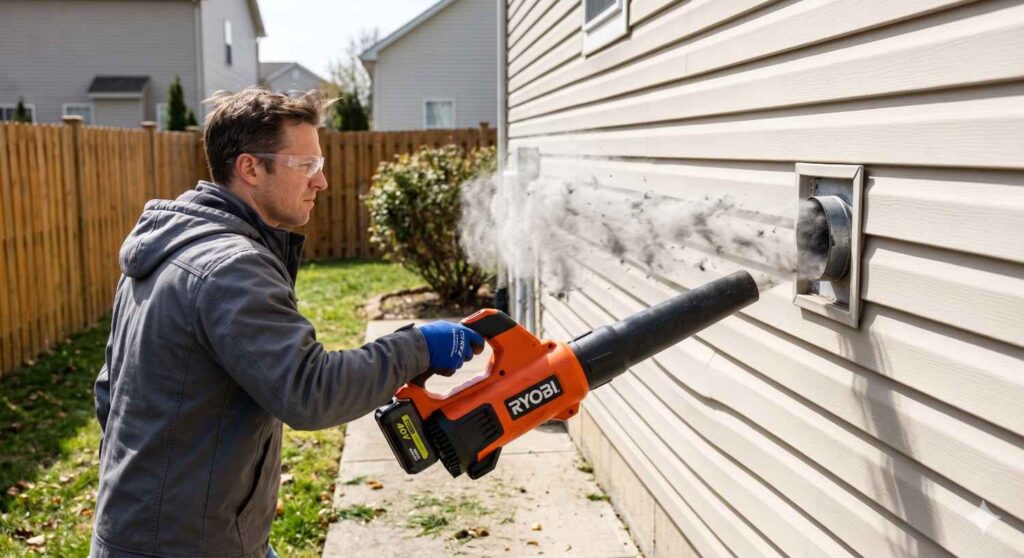
Using a leaf blower to clean a dryer vent is not recommended and can make the problem significantly worse. While the idea seems logical on the surface, the uncontrolled airflow from a leaf blower pushes lint deeper into the duct rather than removing it, creating a more serious fire hazard than the one you started with.
This matters because dryer vent fires are one of the most preventable home hazards. According to the U.S. Fire Administration, clothes dryers cause an estimated 2,900 home fires each year, with failure to clean the dryer vent listed as the leading contributing factor. Choosing the wrong cleaning method does not solve the problem. It disguises it.
This guide explains exactly why leaf blowers fall short, what the real risks are, which tools professionals actually use, and what dryer vent cleaning costs in Alexandria, VA. If you are comparing DIY options to professional service, this is the information you need to make a confident, informed decision.
What Does Dryer Vent Cleaning Actually Involve?
Before evaluating whether a leaf blower can do the job, it helps to understand what dryer vent cleaning actually requires. This is not a simple flush of air through a pipe. It is a systematic process of dislodging, agitating, and extracting accumulated lint from a duct that can run 15 to 35 feet through walls, ceilings, and floor cavities before exiting your home.
The goal is complete lint removal, not displacement. Any method that moves lint from one section of the duct to another without extracting it from the system entirely is not cleaning. It is rearranging a fire hazard.
The Anatomy of a Dryer Vent System
A dryer vent system begins at the back of your dryer, where a short transition hose connects the appliance to the wall. From there, rigid or semi-rigid metal ductwork runs through the interior of your home and terminates at an exterior wall cap or roof vent. The duct may include one or more 90-degree elbows, which are the points where lint accumulates most heavily because airflow slows at each bend.
The exterior vent cap includes a flap or louvered cover that opens when the dryer runs and closes when it is off. This cap can become partially or fully blocked by lint, bird nests, or debris, which forces exhaust air back into the duct and accelerates buildup throughout the system.
Understanding this layout is important because effective cleaning requires tools that can navigate the full length of the duct, reach around bends, and physically dislodge lint from the duct walls rather than simply blowing air through the center of the passage.
What Lint Buildup Looks Like Inside a Vent
Lint does not sit loosely in the center of a dryer duct waiting to be blown out. It adheres to the interior walls of the ductwork, particularly at seams, joints, and elbows. Over time, it compresses into dense, fibrous layers that grip the duct surface. In older or corrugated flexible ducts, lint catches on every ridge and fold, building up in layers that can reduce the duct’s interior diameter by 50 percent or more.
This is why airflow alone, regardless of how forceful, rarely dislodges the material that poses the greatest fire risk. The lint that causes fires is not the loose fluff near the dryer opening. It is the compressed, heat-exposed buildup deep in the duct that has been accumulating for months or years.
Can a Leaf Blower Clean a Dryer Vent? The Short Answer
No. A leaf blower cannot effectively clean a dryer vent, and attempting to use one introduces risks that outweigh any perceived convenience. The core problem is that a leaf blower generates high-volume, uncontrolled airflow without any mechanism for capturing or extracting the material it displaces. In an outdoor setting, that is fine. Inside a sealed duct system, it creates a series of problems that a homeowner may not immediately recognize.
How a Leaf Blower Works vs. How Dryer Vent Cleaning Works
A leaf blower operates by generating a high-velocity stream of air that pushes debris away from the nozzle. It is designed for open environments where displaced material can scatter freely. There is no suction, no agitation, and no collection mechanism.
Professional dryer vent cleaning works on an entirely different principle. It combines mechanical agitation with simultaneous negative pressure extraction. A rotary brush physically scrubs lint from the duct walls while a high-powered vacuum running at the opposite end of the duct creates suction that pulls dislodged material out of the system entirely. The lint is captured, not displaced.
When you insert a leaf blower into a dryer vent, you are applying positive pressure to a closed system. The air has nowhere to go except forward through the duct. Any lint that is not immediately expelled through the exterior vent cap gets compressed further into the duct, packed into elbows, or forced into areas that are even harder to reach. You may see some lint exit at the exterior cap, which creates the false impression that the cleaning worked. The material that remains is typically the most dangerous portion.
Why Airflow Direction and Pressure Matter
Effective dryer vent cleaning requires airflow that moves from the interior of the duct toward the exterior, combined with a vacuum pulling from the dryer end. This directional combination ensures that dislodged lint travels toward the exit point and is captured before it can resettle.
A leaf blower reverses this logic. It pushes air inward from the exterior or from the dryer end, which can force lint in either direction depending on where blockages exist. In a partially blocked duct, the air will follow the path of least resistance, which may not be toward the exterior cap. It may be back into the dryer cabinet itself, depositing lint inside the appliance where it can contact heating elements directly.
Pressure regulation also matters. Professional equipment is calibrated to generate sufficient airflow to move lint without damaging duct connections or flexible transition hoses. A gas-powered leaf blower can generate pressures that exceed what residential ductwork is designed to handle, particularly at joints and seams.
Risks of Using a Leaf Blower on a Dryer Vent
The risks associated with using a leaf blower on a dryer vent are not theoretical. They are the predictable outcomes of applying the wrong tool to a task that requires precision, directionality, and extraction capability. Homeowners who attempt this method often discover the consequences weeks or months later, when dryer performance deteriorates or, in more serious cases, when a fire occurs.
Fire Hazard: Pushing Lint Deeper Into the Duct
Lint is highly flammable. The National Fire Protection Association identifies lint accumulation in dryer vents as a primary cause of residential dryer fires, with the highest incidence occurring in homes where vents have not been cleaned in over a year. When a leaf blower compresses existing lint buildup deeper into the duct, it concentrates the flammable material in areas that receive the most heat exposure during dryer operation.
The elbows and bends in a dryer duct are already the hottest points in the system because airflow slows at each turn, allowing heat to accumulate. Packing additional lint into these areas with a leaf blower creates a concentrated fire risk at exactly the wrong location. The result is a duct that appears to have been cleaned at the accessible ends but contains a dense, heat-exposed lint mass in the middle sections where it is invisible and most dangerous.
Duct Damage from Unregulated Air Pressure
Residential dryer ductwork, particularly the flexible transition hose that connects the dryer to the wall, is not engineered to withstand the pressure output of a leaf blower. Standard flexible aluminum transition hoses are rated for the relatively gentle exhaust pressure of a dryer motor. A leaf blower, especially a gas-powered model, can generate significantly higher pressures that can separate duct joints, collapse flexible sections, or dislodge the duct from its wall connection entirely.
A disconnected or damaged duct is a serious problem. Dryer exhaust contains heat, moisture, and carbon monoxide from gas dryers. If the duct separates inside a wall cavity, these byproducts vent directly into the building structure, creating conditions for mold growth, structural moisture damage, and in gas dryer homes, carbon monoxide accumulation. Duct damage from a DIY cleaning attempt can cost significantly more to repair than a professional cleaning service would have cost in the first place.
Incomplete Cleaning and False Confidence
Perhaps the most underappreciated risk of using a leaf blower is the false sense of security it creates. When a homeowner inserts a leaf blower into the dryer vent and sees lint exit at the exterior cap, the natural conclusion is that the vent has been cleaned. This conclusion is almost always incorrect.
The lint that exits easily is the loose, recently deposited material near the duct openings. The compressed, wall-adhered buildup in the middle sections of the duct, which is the material that causes fires and restricts airflow, does not respond to a blast of uncontrolled air. It stays in place. The homeowner believes the problem is solved and may not schedule a professional cleaning for another year or two, during which time the remaining buildup continues to accumulate and the fire risk continues to grow.
When Homeowners Try DIY Dryer Vent Cleaning (And What Goes Wrong)
The impulse to handle dryer vent cleaning as a DIY project is understandable. The task seems straightforward, the tools seem accessible, and the cost of professional service feels avoidable. But dryer vent cleaning is one of those home maintenance tasks where the gap between what appears to be happening and what is actually happening is wide enough to create serious safety consequences.
Common DIY Methods and Their Limitations
Beyond leaf blowers, homeowners commonly attempt dryer vent cleaning with vacuum cleaner attachments, flexible dryer vent cleaning kits from hardware stores, and compressed air canisters. Each has meaningful limitations.
Vacuum cleaner attachments can remove loose lint from the first few feet of duct near the dryer connection, but standard household vacuums lack the suction power to pull material from the full length of a duct run. They also have no agitation capability, so compacted lint on duct walls remains undisturbed.
Flexible brush kits sold at hardware stores are a better option than leaf blowers and can be effective for short, straight duct runs. However, they have significant limitations in longer runs with multiple elbows. The flexible rods can buckle or disconnect inside the duct, and without simultaneous vacuum extraction, dislodged lint may resettle further down the duct rather than exiting the system.
Compressed air, like a leaf blower, applies positive pressure without extraction. It shares the same fundamental problem: it moves lint rather than removing it.
Signs Your Dryer Vent Was Not Properly Cleaned
If you have attempted a DIY cleaning or hired a low-cost service and are unsure whether the job was done correctly, there are clear indicators that the vent was not properly cleaned.
Your dryer takes longer than one cycle to fully dry a normal load of laundry. The exterior of the dryer feels unusually hot to the touch during operation. The laundry room feels humid or smells musty after a drying cycle. The exterior vent flap does not open fully when the dryer is running, or you notice reduced airflow at the exterior cap. These are all signs of restricted airflow caused by remaining lint buildup.
A properly cleaned dryer vent will show a noticeable improvement in drying time, a reduction in dryer surface temperature, and strong, consistent airflow at the exterior cap during operation.
What Is the Right Way to Clean a Dryer Vent?
The right way to clean a dryer vent involves professional-grade equipment that combines mechanical agitation with simultaneous vacuum extraction, operated by a technician who understands duct routing, connection integrity, and the specific characteristics of your home’s vent system. This is the contextual border between understanding why DIY methods fail and understanding what effective cleaning actually looks like.
The Right Tools for Dryer Vent Cleaning
Professional dryer vent cleaning uses equipment that is specifically engineered for the task. The difference between professional tools and consumer alternatives is not a matter of brand preference. It is a matter of mechanical capability and safety outcome.
Professional Rotary Brush Systems Explained
A rotary brush system consists of a flexible drive rod connected to a spinning brush head, powered by a drill or dedicated motor. The brush head is sized to match the interior diameter of the duct, typically 4 inches for residential dryer vents. As the technician feeds the rod through the duct, the spinning brush physically scrubs lint from the duct walls, including at elbows and bends where buildup is heaviest.
The brush is always used in conjunction with a high-powered vacuum connected at the opposite end of the duct. This simultaneous extraction ensures that lint dislodged by the brush is immediately pulled out of the system rather than being pushed further down the duct. The combination of agitation and extraction is what makes professional cleaning effective where DIY methods are not.
Modern rotary systems also include inspection capabilities. Technicians can attach a small camera to the drive rod to visually confirm that the duct is clear after cleaning, providing documentation that the job was completed thoroughly.
High-Powered Vacuum Equipment vs. Leaf Blowers
The vacuum equipment used in professional dryer vent cleaning operates at a fundamentally different scale than a household vacuum or the reverse airflow of a leaf blower. Professional HEPA-rated vacuums used for duct cleaning generate suction measured in cubic feet per minute that is calibrated to the duct diameter and length, ensuring that negative pressure is maintained throughout the full duct run during cleaning.
This negative pressure is what makes extraction possible. It creates a continuous draw from the dryer end of the duct toward the vacuum, so that every piece of lint dislodged by the rotary brush travels in one direction: out of the duct and into the vacuum’s collection chamber. No lint is left to resettle, no material is pushed into inaccessible areas, and the technician can verify airflow restoration before leaving the property.
A leaf blower generates positive pressure with no extraction. A professional vacuum generates negative pressure with complete extraction. These are not variations of the same approach. They are opposite approaches with opposite outcomes.
How Often Should a Dryer Vent Be Cleaned?
The general industry recommendation, supported by the U.S. Fire Administration, is that dryer vents should be cleaned at least once per year for a typical household. However, this is a baseline, not a universal standard. Several factors can require more frequent cleaning.
Frequency Guidelines Based on Usage and Household Size
A household of two adults doing laundry two to three times per week will accumulate lint at a different rate than a family of five doing laundry daily. Larger households, households with pets, and households that frequently dry heavy items like towels, blankets, and denim should consider cleaning every six months rather than annually.
Duct length and configuration also affect cleaning frequency. A longer duct run with multiple elbows restricts airflow more than a short, straight run, which means lint accumulates faster and cleaning is needed more often. If your dryer vent runs more than 25 feet or includes more than two 90-degree elbows, semi-annual cleaning is a reasonable standard.
Homes in Alexandria, VA where dryers are used year-round without seasonal breaks benefit from consistent annual or semi-annual cleaning schedules. Scheduling a cleaning in the fall before heavy winter laundry use is a practical approach that aligns maintenance with peak demand.
What Does Professional Dryer Vent Cleaning Cost in Alexandria, VA?
Understanding the cost of professional dryer vent cleaning helps homeowners budget accurately and avoid being misled by unusually low offers that may not include complete service. Pricing in the Alexandria, VA area reflects local labor rates, service scope, and the specific characteristics of the vent system being cleaned.
Typical Pricing Ranges for Dryer Vent Cleaning
Professional dryer vent cleaning in Alexandria, VA typically ranges from $89 to $175 for a standard residential service. This range covers a single dryer vent with a duct run of typical length and configuration. The service should include a full inspection of the vent system, rotary brush cleaning of the complete duct run, vacuum extraction, and verification of airflow at the exterior cap.
Prices below $75 for a complete dryer vent cleaning should be approached with caution. At that price point, the service may involve only a partial cleaning of the accessible sections near the dryer, without addressing the full duct run. This is the type of service that leaves the most dangerous lint buildup in place while giving the appearance of a completed job.
Prices above $200 for a standard single-dryer residential cleaning may indicate unnecessary add-ons or upsells. A straightforward dryer vent cleaning does not require chemical treatments, antimicrobial coatings, or extensive diagnostic packages unless a specific problem has been identified and explained to the homeowner.
What Factors Affect the Cost of Dryer Vent Cleaning
Several variables influence the final cost of a dryer vent cleaning service. Duct length is the primary factor. A duct run of 10 to 15 feet is straightforward to clean and falls at the lower end of the pricing range. A run of 25 to 35 feet with multiple elbows requires more time, more rod extensions, and more careful technique, which is reflected in a higher price.
Duct accessibility also affects cost. If the duct runs through a finished wall with no access panels, or if the exterior vent cap is located on a roof rather than a side wall, the technician requires additional time and equipment to complete the service safely. Roof-mounted vent caps may require ladder access and additional safety precautions.
The condition of the duct itself can affect pricing. A duct that has not been cleaned in several years and contains heavy, compacted buildup requires more passes with the rotary brush and more time to fully clear. Some contractors charge a standard rate for routine maintenance cleaning and a higher rate for remediation cleaning when the duct is severely blocked.
Bundling dryer vent cleaning with air duct cleaning or HVAC cleaning services often results in a lower combined price than booking each service separately. If you are already scheduling air duct cleaning for your Alexandria, VA home, adding dryer vent cleaning to the same appointment is typically the most cost-effective approach.
What to Expect From a Professional Dryer Vent Cleaning Service
Knowing what a professional service should include helps you evaluate contractors accurately and recognize when a service is incomplete. A thorough dryer vent cleaning is not a 10-minute job, and a technician who completes the work in under 20 minutes without using a vacuum has almost certainly not cleaned the full duct run.
Step-by-Step: What a Technician Does During a Service Visit
A professional dryer vent cleaning service begins with a visual inspection of the dryer connection, the transition hose, and the accessible sections of ductwork. The technician checks for proper duct material (rigid or semi-rigid metal is preferred over flexible foil or plastic), confirms the duct connections are secure, and identifies any visible damage or improper installation.
The technician then disconnects the dryer from the wall connection to access the full duct opening. A high-powered vacuum is connected at the dryer end of the duct, and the rotary brush system is inserted from either the dryer end or the exterior cap end, depending on the duct configuration. The brush is advanced through the full length of the duct in sections, with the vacuum running continuously to capture dislodged lint.
After the brush pass is complete, the technician verifies airflow at the exterior cap, confirms that the flap opens fully and closes completely, and checks that no lint remains visible at either end of the duct. The dryer is reconnected, and the technician may run a brief test cycle to confirm that exhaust airflow is restored to normal levels.
A written summary of the service, including the duct length cleaned, any issues identified, and recommendations for future maintenance, is a mark of a professional contractor who stands behind their work.
How to Choose a Trustworthy Dryer Vent Cleaning Contractor
The dryer vent cleaning industry includes a range of service providers, from certified professionals with industry training to unlicensed operators offering low prices with minimal service. Knowing what to look for protects you from paying for incomplete work.
Look for contractors who are certified by the National Air Duct Cleaners Association (NADCA) or who can demonstrate training in dryer vent cleaning specifically. NADCA certification indicates that the contractor has met industry standards for equipment, technique, and service scope.
Ask specifically what equipment will be used. A contractor who cannot describe their rotary brush system and vacuum extraction process in clear terms may not be using professional-grade equipment. Ask whether the full duct run will be cleaned or only the accessible sections near the dryer.
Request a written estimate before the service begins, and confirm that the quoted price covers the complete service including inspection, full duct cleaning, and airflow verification. A transparent contractor will provide this information without hesitation. A contractor who is vague about scope or who adds charges after the service is complete is not operating with the transparency that homeowners deserve.
In Alexandria, VA, where homes range from older townhouses with complex duct routing to newer single-family homes with straightforward installations, working with a contractor who has local experience and can assess your specific system accurately is a meaningful advantage.
Conclusion
Using a leaf blower to clean a dryer vent is not a safe or effective alternative to professional service. It pushes lint deeper into the duct, creates concentrated fire hazards at the bends and elbows where heat accumulates most, and provides a false sense of completion that delays proper maintenance. The right approach combines rotary brush agitation with simultaneous vacuum extraction, performed by a trained technician using calibrated equipment.
At AirDuctVet Dryer and Vent Cleaning Services, we provide complete dryer vent cleaning for homeowners, landlords, and property managers throughout Alexandria, VA. Our process covers the full duct run, uses professional-grade equipment, and includes airflow verification so you leave with confidence that the job was done correctly, not just quickly.
If your dryer is taking longer to dry clothes, running hotter than usual, or has not had its vent cleaned in over a year, contact AirDuctVet Dryer and Vent Cleaning Services today to schedule a professional inspection and cleaning. Transparent pricing, no unnecessary upsells, and industry-approved methods are what we bring to every service call.
Frequently Asked Questions
Can a leaf blower unclog a dryer vent?
A leaf blower cannot reliably unclog a dryer vent. It applies positive pressure without extraction, which pushes lint further into the duct rather than removing it. For a true unclogging, you need rotary brush agitation combined with vacuum extraction to physically dislodge and capture the blockage.
Is it safe to use a leaf blower to clean a dryer vent?
No, it is not safe. Using a leaf blower on a dryer vent can compress flammable lint into the hottest sections of the duct, increasing fire risk. It can also damage flexible transition hoses and duct connections due to unregulated air pressure, potentially causing exhaust to vent inside wall cavities.
What is the best tool to clean a dryer vent?
The most effective tool combination for dryer vent cleaning is a professional rotary brush system paired with a high-powered HEPA vacuum. The brush physically scrubs lint from duct walls while the vacuum simultaneously extracts it from the system. This combination is what professional contractors use and what produces a genuinely clean duct.
How do I know if my dryer vent is clogged?
The most common signs of a clogged dryer vent include clothes taking more than one cycle to dry fully, the dryer exterior feeling unusually hot during operation, a musty or burning smell in the laundry room, and reduced or no airflow at the exterior vent cap. Any of these signs warrants a professional inspection.
How much does dryer vent cleaning cost in Alexandria, VA?
Professional dryer vent cleaning in Alexandria, VA typically costs between $89 and $175 for a standard residential service. The final price depends on duct length, number of elbows, accessibility of the exterior cap, and the overall condition of the duct. Bundling with air duct cleaning often reduces the combined cost.
How often should dryer vents be cleaned?
Most households should have their dryer vent cleaned at least once per year. Larger households, homes with pets, or homes with longer duct runs and multiple elbows benefit from cleaning every six months. If your dryer performance has declined noticeably, cleaning may be needed regardless of when the last service was performed.
What happens if you never clean your dryer vent?
If a dryer vent is never cleaned, lint accumulates to the point where airflow is severely restricted. This forces the dryer to work harder and run hotter, shortening the appliance’s lifespan and dramatically increasing the risk of a dryer vent fire. The U.S. Fire Administration identifies failure to clean as the leading cause of dryer fires in residential homes.
