Shampooing your carpet without knowing the common mistakes can leave your floors wetter, dirtier, and more damaged than before you started. Over-wetting, skipping vacuuming, using the wrong solution, and scrubbing instead of blotting are among the most damaging errors homeowners make. This guide covers every critical mistake to avoid so your carpet cleaning effort actually works.
These mistakes matter because they don’t just affect appearance. They can cause mold growth under padding, void carpet warranties, and push contaminants deeper into fibers where they affect the air your family breathes every day.
Below, you’ll find a complete breakdown of what not to do when shampooing carpet, why each mistake causes real damage, and when it’s time to stop DIY cleaning and call a professional.
Why Carpet Shampooing Mistakes Are More Costly Than You Think
Most homeowners approach carpet shampooing as a straightforward chore. Pour in the solution, run the machine, let it dry. But the gap between doing it right and doing it wrong is wider than most people realize, and the consequences go well beyond a damp floor.
Incorrect carpet shampooing can permanently distort fibers, create conditions for mold and mildew growth, leave behind sticky residue that attracts more dirt, and in some cases, completely void your carpet manufacturer’s warranty. What starts as a cost-saving DIY project can quickly turn into an expensive replacement.
For homeowners in Alexandria, VA, where humidity levels can already make drying times longer, these risks are amplified. Understanding what not to do is just as important as knowing the right technique.
What happens when you shampoo carpet incorrectly?
When you shampoo carpet incorrectly, you risk over-saturating the backing and padding with water, leaving soap residue that accelerates resoiling, distorting pile fibers through aggressive scrubbing, and creating a moist environment beneath the surface where mold and bacteria thrive. In severe cases, the subfloor itself can absorb moisture and warp or rot over time.
Using Too Much Water or Shampoo Solution
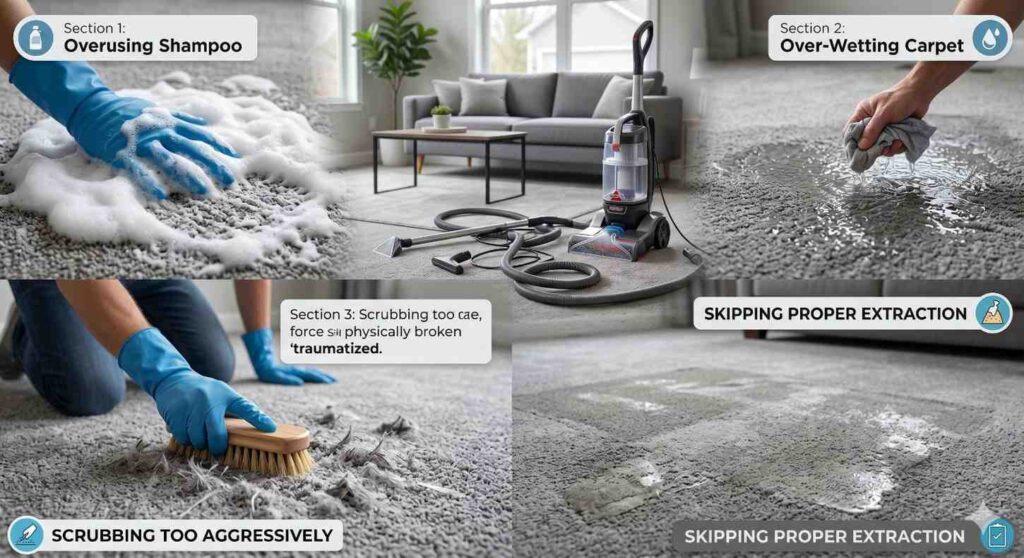
Over-wetting is the single most common and most damaging mistake in DIY carpet shampooing. It happens when too much water or cleaning solution is applied, saturating not just the carpet fibers but the backing, the padding, and sometimes the subfloor beneath.
Carpet fibers are designed to release moisture relatively quickly when cleaned correctly. The padding underneath is not. Once padding becomes saturated, it acts like a sponge, holding moisture for days. That trapped moisture creates the ideal environment for mold, mildew, and bacteria, none of which are visible until the problem is already serious.
The instinct to use more solution to tackle tough stains is understandable but counterproductive. More solution means more residue, longer drying times, and a higher risk of structural damage to the carpet and the floor beneath it.
How much water is too much when shampooing carpet?
A properly cleaned carpet should feel slightly damp to the touch immediately after cleaning, not wet. If water pools on the surface, if the carpet feels heavy and saturated, or if you can press down and feel moisture seeping up, you have used too much water. Most professional-grade equipment is calibrated to apply minimal moisture while still delivering effective cleaning.
What causes carpet to stay wet for days after cleaning?
Carpet stays wet for days after cleaning primarily because of over-saturation, poor ventilation, or inadequate extraction during the cleaning process. When too much water is applied and the machine’s suction cannot remove it efficiently, the moisture migrates into the padding and backing. Without airflow from open windows, fans, or a dehumidifier, that moisture has nowhere to go. In humid climates like Alexandria, VA, this problem is significantly worse during summer months.
Not Vacuuming Before You Shampoo
Skipping the pre-vacuum step is a mistake that undermines the entire cleaning process before it even begins. Dry soil, pet hair, dust, and debris sitting on top of carpet fibers will turn into a muddy paste the moment they contact water and cleaning solution. That paste is far harder to extract than loose dry particles, and it often gets pushed deeper into the carpet pile during the shampooing process.
Vacuuming before shampooing removes the loose surface layer of contamination so the cleaning solution can actually reach the embedded dirt and stains it’s designed to address. Without this step, you’re essentially cleaning the top layer of debris while sealing the deeper contamination in place.
A thorough pre-vacuum should cover the entire area at least twice, once in each direction, with special attention to high-traffic zones where debris is most compacted.
Does vacuuming before shampooing really make a difference?
Yes, vacuuming before shampooing makes a significant difference. Dry soil accounts for a large portion of carpet contamination, and removing it before introducing moisture prevents it from turning into embedded mud. Carpet cleaning professionals consistently list pre-vacuuming as a non-negotiable step because it directly affects how clean the final result will be and how quickly the carpet dries afterward.
Using the Wrong Cleaning Solution for Your Carpet Type
Not all carpet cleaning solutions are created equal, and not all carpets respond the same way to the same chemicals. Using a solution that isn’t compatible with your carpet’s fiber type is one of the fastest ways to cause permanent, irreversible damage.
Synthetic fibers like nylon and polyester are generally more tolerant of a wider range of cleaning agents. Natural fibers like wool, sisal, and cotton are far more sensitive. Alkaline solutions can cause wool fibers to felt and shrink. Bleach-based products can strip color from any fiber type. Enzyme-based cleaners, while excellent for pet stains on synthetic carpets, can degrade natural protein fibers like wool and silk.
Before applying any cleaning solution, check your carpet’s care label or manufacturer documentation. If that information isn’t available, test any solution in a small, hidden area and wait at least 24 hours before proceeding with the full cleaning.
What cleaning solutions are safe for wool or delicate carpet fibers?
For wool and other delicate natural fiber carpets, use pH-neutral cleaning solutions specifically formulated for wool or labeled as safe for natural fibers. Avoid any product with a high alkaline pH, optical brighteners, or bleaching agents. Many professional carpet cleaners use wool-safe solutions that clean effectively without disrupting the fiber’s natural lanolin coating, which gives wool its resilience and texture.
Can the wrong shampoo permanently damage carpet?
Yes, the wrong shampoo can permanently damage carpet. Alkaline solutions can cause wool to shrink and felt, a process that cannot be reversed. Bleach-based products can strip dye from synthetic and natural fibers alike, leaving permanent discoloration. Harsh solvents can dissolve the latex backing that holds carpet fibers in place, causing the carpet to delaminate and fall apart. Once these types of damage occur, replacement is typically the only option.
Scrubbing Instead of Blotting Stains
The instinct to scrub a stain aggressively is almost universal, but it is one of the most damaging things you can do to carpet fibers. Scrubbing spreads the stain outward, pushes it deeper into the pile, and physically distorts or breaks the fibers themselves. The result is a stain that covers a larger area and a section of carpet that looks visibly worn or matted even after the stain is removed.
The correct technique is always to blot, not scrub. Blotting applies gentle downward pressure to absorb the stain from the carpet into the cleaning cloth. Work from the outside edge of the stain inward toward the center to prevent spreading. Use a clean white cloth or paper towel and change it frequently so you’re lifting the stain rather than redistributing it.
For dried or set-in stains, apply a small amount of appropriate cleaning solution, allow it to dwell for a few minutes to loosen the stain, then blot. Repeat as needed rather than increasing pressure or switching to a scrubbing motion.
Why does scrubbing make carpet stains worse?
Scrubbing makes carpet stains worse because the friction spreads the staining agent laterally across a wider area while simultaneously pushing it deeper into the fiber structure. The mechanical action also untwists and distorts carpet fibers, creating a fuzzy, matted appearance that remains visible even after the stain itself is gone. In some cases, aggressive scrubbing can permanently damage the fiber tips, leaving a section of carpet that looks different from the surrounding area regardless of how clean it is.
Skipping a Proper Rinse After Shampooing
Leaving cleaning solution residue in your carpet is a problem that compounds over time. Carpet shampoo is designed to attract and suspend dirt so it can be extracted. When residue is left behind, it continues doing exactly that, attracting new dirt from foot traffic, pet activity, and airborne particles. The result is a carpet that looks clean immediately after washing but becomes visibly dirty again within days or weeks.
Residue buildup also makes carpet fibers feel stiff, sticky, or crunchy underfoot. Over time, it can alter the texture of the pile and make the carpet harder to clean in future sessions because the residue layer traps new contamination more aggressively.
A proper rinse step, using clean water with no added solution, should follow every shampooing session. Run the machine over the cleaned area with plain water to extract as much residue as possible, then follow with a final extraction pass to remove the rinse water.
What happens if you don’t rinse carpet shampoo out completely?
If you don’t rinse carpet shampoo out completely, the remaining surfactants and cleaning agents continue to attract dirt long after the carpet appears clean. This accelerated resoiling means the carpet will look dirty again much faster than it should. Over time, residue buildup can also cause discoloration, alter fiber texture, and make the carpet progressively harder to clean because each new layer of contamination bonds to the existing residue layer.
Not Allowing Enough Drying Time
Rushing the drying process, or simply not accounting for how long carpet actually needs to dry, is one of the most common causes of mold and mildew problems in residential carpet. Many homeowners assume carpet is dry once the surface feels dry to the touch. In reality, the padding and backing beneath can remain saturated for significantly longer.
Walking on wet carpet compresses the fibers and pushes moisture deeper into the padding. Replacing furniture on wet carpet traps moisture underneath, creating dark, humid pockets where mold can establish itself within 24 to 48 hours. Closing windows and doors to maintain temperature also slows evaporation and extends drying time.
After shampooing, maximize airflow by opening windows, running ceiling fans, and using portable fans directed at the carpet surface. A dehumidifier is particularly effective in humid climates. Avoid walking on the carpet until it is completely dry, and do not replace furniture until you are certain the carpet and padding are fully dry throughout.
How long should carpet take to dry after shampooing?
Carpet should typically take between 6 and 24 hours to dry completely after shampooing under normal conditions. Factors that extend drying time include high ambient humidity, poor ventilation, thick carpet pile, dense padding, and over-saturation during cleaning. In humid climates like Alexandria, VA, drying times can extend beyond 24 hours without active airflow or dehumidification. Professional cleaning equipment extracts significantly more moisture than rental machines, which is one reason professionally cleaned carpets often dry faster.
Can wet carpet cause mold under the padding?
Yes, wet carpet can cause mold under the padding. Mold requires moisture, a food source, and the right temperature to grow, and carpet padding provides all three. When padding remains wet for more than 24 to 48 hours, mold colonies can begin to establish themselves. Because the mold grows beneath the carpet surface, it is often not visible until it has spread significantly. Signs of mold under carpet padding include a persistent musty odor, unexplained allergy symptoms, and visible discoloration at the carpet edges or seams.
Renting the Wrong Equipment or Using Improper Machines
Consumer-grade rental carpet shampooers are widely available and relatively affordable, but they are not equivalent to professional cleaning equipment in terms of water pressure, solution delivery, or extraction power. The most critical difference is suction. Professional truck-mounted systems generate significantly more extraction force than portable rental units, which means they remove far more moisture and residue from the carpet during the cleaning process.
Using an underpowered machine means more water stays in the carpet after cleaning, extending drying time and increasing the risk of mold and residue buildup. It also means less effective removal of embedded soil, pet dander, and allergens from deep within the carpet pile.
Beyond suction power, using the wrong type of machine for your carpet type can cause damage. Rotary brush machines, for example, can distort or mat certain carpet pile types. High-pressure systems can over-wet delicate fibers. Matching the equipment to the carpet type and condition is as important as using the right cleaning solution.
Is a rental carpet shampooer as effective as professional equipment?
Rental carpet shampooers are not as effective as professional equipment. Professional truck-mounted systems operate at significantly higher water pressure and extraction vacuum levels than consumer rental units. This means deeper cleaning, more effective residue removal, and substantially faster drying times. For routine light maintenance cleaning, a rental machine may be adequate. For deep cleaning, heavily soiled carpet, or carpet with embedded allergens and pet dander, professional equipment delivers meaningfully better results.
Ignoring Manufacturer Guidelines and Carpet Warranties
Every carpet manufacturer provides care and maintenance guidelines specific to their product. These guidelines exist because different fiber types, pile constructions, and backing materials respond differently to cleaning methods, solutions, and equipment. Ignoring these guidelines doesn’t just risk damaging the carpet. It can void the manufacturer’s warranty entirely.
Most carpet warranties include specific language about approved cleaning methods. Some require professional cleaning at defined intervals to maintain warranty coverage. Others prohibit specific cleaning agents or methods that can damage the fiber or backing. If you use a method or product that isn’t approved and the carpet is subsequently damaged, the manufacturer is under no obligation to honor the warranty claim.
Before shampooing any carpet, locate the manufacturer’s care label and any documentation that came with the carpet. If that information is no longer available, contact the manufacturer directly or consult a certified carpet cleaning professional who can identify the fiber type and recommend appropriate cleaning methods.
Can DIY shampooing void your carpet warranty?
Yes, DIY shampooing can void your carpet warranty if the method or products used are not approved by the manufacturer. Many carpet warranties specify that cleaning must be performed by a certified professional using approved methods, or that only certain types of cleaning solutions may be used. Using a rental machine with an incompatible cleaning solution, or applying too much water and causing backing damage, can give the manufacturer grounds to deny a warranty claim. Always review your warranty documentation before attempting any DIY cleaning.
When DIY Carpet Shampooing Causes More Harm Than Good
There is a point at which DIY carpet shampooing stops being a cost-effective solution and starts creating problems that cost significantly more to fix than a professional cleaning would have. Recognizing that point before you reach it is the key to protecting your investment.
Heavy soiling, pet urine contamination, mold or mildew presence, and delicate or specialty fiber carpets are all situations where DIY shampooing is likely to make the problem worse rather than better. Pet urine, for example, penetrates through the carpet fiber, through the backing, and into the padding. Surface cleaning with a rental machine addresses only the top layer, leaving the odor-causing bacteria and urine salts in the padding where they continue to cause problems.
Similarly, if your carpet has any visible mold, attempting to clean it yourself without proper containment and antimicrobial treatment can spread mold spores to other areas of the home. This is a situation that requires professional remediation, not a rental shampooer.
What are signs your carpet needs professional deep cleaning?
Signs that your carpet needs professional deep cleaning include a persistent musty or sour odor that doesn’t resolve after cleaning, visible staining that returns after DIY treatment, carpet that feels stiff or sticky after cleaning due to residue buildup, unexplained allergy or respiratory symptoms in household members, visible discoloration or dark spots at carpet edges or seams, and pet urine odor that persists despite surface treatment. Any of these signs indicates contamination that has penetrated beyond the surface layer and requires professional equipment and methods to address effectively.
How Professional Carpet and Indoor Air Quality Services Protect Your Home
Carpet and indoor air quality are more closely connected than most homeowners realize. Carpet acts as a filter for your indoor environment, trapping dust, pet dander, pollen, mold spores, and other airborne particles within its fibers. When that filter becomes overloaded, it stops trapping contaminants and starts releasing them back into the air with every footstep.
This connection extends to your HVAC system. Contaminants released from heavily soiled carpet are drawn into your home’s air circulation system, where they accumulate in air ducts and on HVAC components. Over time, this buildup reduces system efficiency, degrades indoor air quality, and can contribute to respiratory issues for household members, particularly those with allergies or asthma.
Professional cleaning services address both sides of this equation. Properly cleaned carpet retains its filtration function, trapping contaminants rather than releasing them. Combined with professional air duct cleaning, which removes accumulated debris from the HVAC system itself, homeowners can achieve a meaningful improvement in overall indoor air quality.
How does dirty carpet affect indoor air quality and your HVAC system?
Dirty carpet affects indoor air quality by releasing trapped contaminants, including dust mites, pet dander, mold spores, and bacteria, back into the breathing zone with every footstep or air movement. These particles are then drawn into the HVAC system through return air vents, where they accumulate in air ducts, on coils, and on other components. This accumulation reduces airflow efficiency, can promote mold growth within the duct system, and continuously recirculates contaminants throughout the home. Regular professional carpet cleaning, combined with periodic air duct cleaning, is the most effective way to interrupt this cycle and maintain healthy indoor air quality.
Conclusion
Shampooing carpet incorrectly creates problems that range from accelerated resoiling and fiber damage to mold growth and voided warranties. The most damaging mistakes, over-wetting, skipping pre-vacuuming, using the wrong solution, scrubbing instead of blotting, and failing to rinse thoroughly, are also the most common, which means most DIY carpet cleaning falls short of what the carpet actually needs.
At AirDuctVet Dryer & Vent Cleaning Services, we understand that clean floors and clean air are part of the same equation. Heavily soiled carpet doesn’t just look bad. It actively degrades the indoor air quality your HVAC system works to maintain, pushing contaminants into your duct system and back into your home’s breathing zone.
If your carpet has reached the point where DIY shampooing is doing more harm than good, or if you’re concerned about how carpet contamination may be affecting your home’s air quality, contact AirDuctVet Dryer & Vent Cleaning Services in Alexandria, VA. Our team provides professional, transparent service that protects both your floors and the air your family breathes every day.
Frequently Asked Questions
Is it bad to shampoo carpet too often?
Yes, shampooing carpet too often can break down fiber structure, strip protective coatings, and cause premature wear. Most carpet manufacturers recommend professional cleaning every 12 to 18 months, with spot treatment for stains in between.
What should you not put in a carpet shampooer?
Never put bleach, undiluted dish soap, laundry detergent, or any product not specifically formulated for carpet cleaning machines into a carpet shampooer. These products create excessive foam, leave heavy residue, and can damage both the machine and the carpet fibers.
Should you open windows after shampooing carpet?
Yes, opening windows after shampooing carpet is strongly recommended. Increased airflow accelerates evaporation and reduces drying time significantly. Combine open windows with ceiling fans and portable fans directed at the carpet surface for the fastest and most complete drying.
Can you walk on carpet right after shampooing?
You should avoid walking on carpet immediately after shampooing. Walking on wet carpet compresses fibers, pushes moisture deeper into the padding, and can transfer dirt from shoes back onto the clean surface. Wait until the carpet is completely dry, which typically takes 6 to 24 hours depending on conditions.
Why does my carpet look worse after shampooing?
Carpet can look worse after shampooing due to residue buildup from insufficient rinsing, wicking of deep-set stains as the carpet dries, fiber distortion from scrubbing, or over-wetting that has caused the backing to release adhesives or dyes. If your carpet consistently looks worse after cleaning, professional cleaning with proper extraction equipment is likely needed.
How do you know if carpet is too wet after shampooing?
Carpet is too wet after shampooing if it feels heavy and saturated rather than slightly damp, if water pools on the surface when you press down, if it remains wet to the touch after 24 hours, or if you notice a musty smell developing within the first day. These are all signs of over-saturation that require immediate action to increase airflow and prevent mold growth.
Does shampooing carpet remove allergens?
Shampooing carpet can reduce allergen levels, but effectiveness depends heavily on the equipment and method used. Professional hot water extraction removes significantly more allergens, including dust mite debris, pet dander, and mold spores, than consumer rental machines. For households with allergy or asthma sufferers, professional cleaning combined with HEPA vacuuming provides the most meaningful allergen reduction.

