
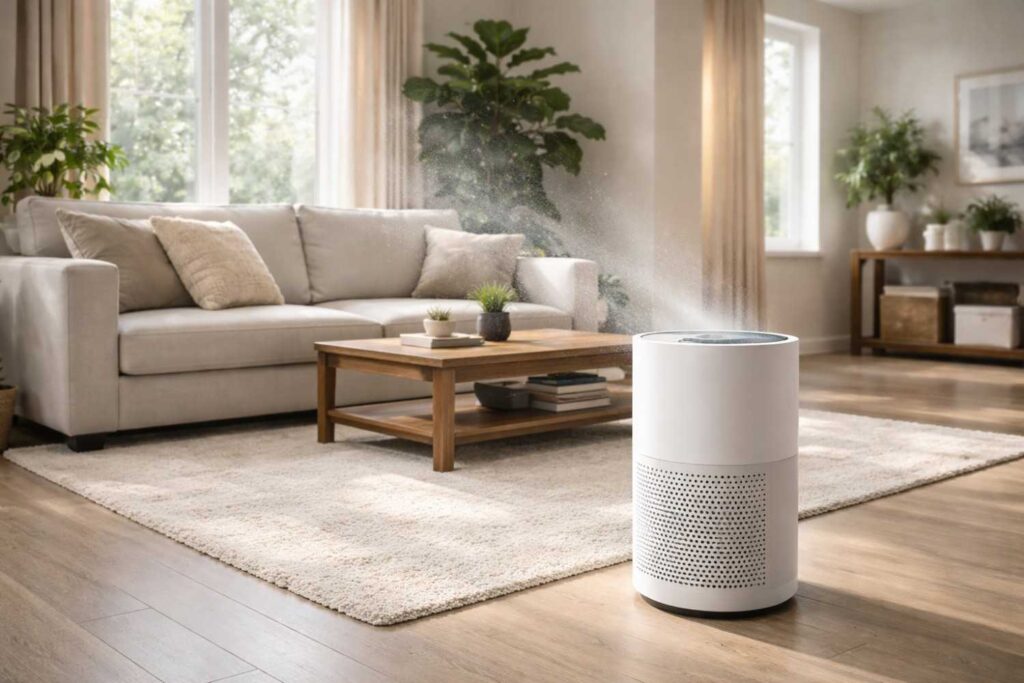
The best air purifier for dust uses a True HEPA filter with a high Clean Air Delivery Rate, and models from Honeywell, Levoit, and Blueair consistently lead independent testing for particle removal in homes across Alexandria, VA.
But here is what most “best of” lists will not tell you: an air purifier only captures dust already floating in your air. It does nothing about the dust packed inside your ductwork, recirculating every time your HVAC kicks on.
This guide covers top-rated purifiers, the filtration technology behind them, and the critical step most homeowners skip when fighting dust at its actual source.
Why Dust Is a Persistent Indoor Air Quality Problem in Alexandria, VA
Alexandria sits in a humid mid-Atlantic climate where pollen seasons stretch long, construction activity stirs fine particulate into neighborhoods, and older homes with aging HVAC systems trap decades of accumulated debris. Dust is not just an annoyance here. It is a year-round indoor air quality challenge that affects respiratory health, HVAC efficiency, and the cleanliness of every surface in your home.
The EPA estimates that indoor air can be two to five times more polluted than outdoor air. In a region like Northern Virginia, where homes stay sealed for both summer cooling and winter heating, airborne dust particles recirculate continuously through forced-air systems.
Common Sources of Household Dust
Dust is not one substance. It is a mixture of dead skin cells, pet dander, fabric fibers, pollen, mold spores, insect waste, and fine soil particles tracked indoors. In Alexandria homes, common contributors include:
- Pet hair and dander from dogs and cats, which become airborne and settle into ductwork
- Pollen and outdoor particulate entering through open windows, door seals, and HVAC intake vents
- Construction debris from nearby development projects or home renovations
- Fabric fibers shed by carpets, upholstery, bedding, and clothing
- Deteriorating HVAC filters that allow particles to pass through and deposit inside ducts
Each of these sources generates particles of different sizes. Larger particles settle on surfaces quickly. Smaller particles, often under 10 microns, stay suspended in the air for hours and penetrate deep into lungs when inhaled.
How Dust Affects Your HVAC System and Air Ducts
Every time your heating or cooling system runs, it pulls air through return ducts, passes it over a filter, conditions it, and pushes it back through supply ducts into your rooms. Dust accumulates at every stage of this cycle.
Clogged filters restrict airflow, forcing your system to work harder and increasing energy bills. Dust buildup on evaporator coils reduces heat exchange efficiency. And the interior walls of your ductwork collect layers of debris that no standard furnace filter can reach.
This means your HVAC system can become the largest dust distribution network in your home. A clean-looking vent grille can hide inches of accumulated dust just behind the register. That dust re-enters your living space with every heating or cooling cycle, making it impossible to keep surfaces clean no matter how often you dust or vacuum.
How Air Purifiers Remove Dust from Indoor Air
Air purifiers work by drawing room air through one or more filtration stages, trapping particles, and returning cleaner air to the space. The effectiveness of any purifier depends on three factors: the type of filter it uses, the volume of air it can process, and the size of particles it captures.
Not all air purifiers handle dust equally. Some technologies excel at trapping fine particulate. Others target gases and odors but do little for solid dust particles. Understanding these differences is essential before spending money on a unit that may not solve your specific problem.
HEPA Filtration and Why It Matters for Dust
True HEPA (High Efficiency Particulate Air) filters are the gold standard for dust removal. By definition, a True HEPA filter captures 99.97% of particles as small as 0.3 microns. That includes the fine dust, pollen, mold spores, and pet dander that cause the most respiratory irritation.
The key distinction is between “True HEPA” and “HEPA-type” or “HEPA-style” filters. HEPA-type filters are not held to the same testing standard and may only capture particles down to 2 to 5 microns, missing the smallest and most harmful dust fraction.
For dust control in an Alexandria home, a True HEPA filter is non-negotiable. It is the single most important specification to verify before purchasing any air purifier.
Activated Carbon, Ionizers, and UV-C Filters Compared
Beyond HEPA, many air purifiers include secondary filtration stages. Here is what each does and does not do for dust:
Activated carbon filters absorb volatile organic compounds (VOCs), odors, and chemical fumes. They do very little for solid dust particles. If dust is your primary concern, activated carbon is a bonus feature, not a deciding factor.
Ionizers release charged ions that attach to airborne particles, causing them to settle onto surfaces or collect on charged plates inside the unit. Some ionizers produce trace amounts of ozone, which the California Air Resources Board warns can irritate lungs. Ionizers can supplement HEPA filtration but should not replace it for dust.
UV-C light targets bacteria, viruses, and mold spores by damaging their DNA. It has no meaningful effect on inert dust particles. UV-C is useful for biological contaminants but irrelevant to dust removal.
For dust-specific performance, prioritize True HEPA first. Treat everything else as supplementary.
CADR Ratings and Room Size Coverage Explained
The Clean Air Delivery Rate (CADR) measures how quickly an air purifier can filter a specific volume of air. CADR is rated separately for dust, smoke, and pollen. For dust control, look at the dust-specific CADR number.
A higher dust CADR means faster, more thorough air cleaning. The Association of Home Appliance Manufacturers (AHAM) recommends choosing a purifier with a dust CADR that is at least two-thirds of your room’s square footage. For a 300-square-foot bedroom, you want a dust CADR of at least 200.
Room size coverage listed by manufacturers often assumes standard 8-foot ceilings. If your Alexandria home has higher ceilings, older open floor plans, or connected rooms, size up. Running a purifier rated for a smaller space in a larger room means it will never fully cycle the air volume needed to make a noticeable difference.
Best Air Purifiers for Dust in 2025
Choosing the right air purifier depends on your room size, budget, and whether you need additional filtration for allergens or chemicals. The following recommendations are based on True HEPA filtration, verified CADR ratings, filter replacement costs, and real-world performance for dust-heavy environments.
Best Overall Air Purifier for Dust (Whole-Home Use)
The Blueair Blue Pure 211+ Auto consistently ranks among the top performers for dust removal. It delivers a dust CADR of 350, covers rooms up to 550 square feet, and uses a combination of mechanical and electrostatic filtration to capture fine particles efficiently.
Its washable pre-filter extends the life of the main HEPA filter, and the unit operates quietly enough for living rooms and open-plan spaces. Filter replacement runs approximately $40 to $60 every six months depending on usage and dust load.
For Alexandria homeowners looking for a single unit that handles a large living area, this is the strongest all-around choice.
Best Budget Air Purifier for Dust
The Levoit Core 300S offers True HEPA filtration with a dust CADR of 140 at a price point under $100. It covers rooms up to 219 square feet, making it well-suited for bedrooms, home offices, and smaller living spaces.
Replacement filters cost around $20 to $25 and last roughly six to eight months. The unit includes smart app control and auto mode, which adjusts fan speed based on real-time air quality readings. For renters or homeowners testing air purification before committing to a larger investment, the Core 300S delivers reliable dust capture without a significant upfront cost.
Best Air Purifier for Dust and Allergies
The Honeywell HPA300 is a workhorse designed for allergy sufferers dealing with dust, pollen, and pet dander simultaneously. Its True HEPA filter captures 99.97% of microscopic allergens, and its dust CADR of 300 handles rooms up to 465 square feet.
This model uses a turbo setting for rapid air cleaning during high-pollen days or after activities that stir up dust, like vacuuming or construction nearby. Filter costs are moderate at $30 to $50 for HEPA replacements every 12 months, with pre-filters changed every three months.
For Alexandria homes where seasonal allergies compound the dust problem, the HPA300 addresses both issues in a single unit.
Best Air Purifier for Large Rooms with Heavy Dust
The Coway Airmega 400 handles spaces up to 1,560 square feet with a dual-filter system that combines True HEPA and activated carbon filtration. Its dust CADR of 350 matches top-tier competitors, and the unit includes a real-time air quality indicator and auto-adjusting fan speed.
For property managers overseeing larger rental units or homeowners with open floor plans, the Airmega 400 provides coverage that eliminates the need for multiple smaller units. HEPA filters last approximately 12 months, and the unit alerts you when replacement is needed.
This is the right choice when dust accumulation is heavy, square footage is large, and you want set-it-and-forget-it operation.
Key Features to Look for in a Dust Air Purifier
Specifications matter more than marketing claims. Before purchasing, evaluate these features to ensure the unit you choose actually solves your dust problem rather than just moving air around.
Filter Type and Replacement Cost
True HEPA is the baseline requirement. Beyond that, calculate the annual cost of filter replacements before committing to a model. Some purifiers with lower purchase prices carry expensive proprietary filters that cost $80 to $120 per replacement cycle.
Over a three-year ownership period, a $150 purifier with $25 filters every six months costs $300 in filters alone. A $250 purifier with $40 annual filter replacements costs $120 total. The cheaper unit ends up costing more.
Always check filter availability. Some brands discontinue filters for older models, turning a functional purifier into an expensive paperweight.
Noise Level, Energy Use, and Smart Features
Noise output matters if the purifier runs in a bedroom or home office. Look for units rated below 50 decibels on their lowest setting. Many models list noise levels only at the lowest fan speed, so check specifications for medium and high settings as well.
Energy consumption varies widely. Most residential air purifiers draw between 30 and 70 watts on standard settings. Units with auto mode save energy by reducing fan speed when air quality sensors detect lower particle counts.
Smart features like app control, scheduling, and filter life monitoring add convenience but should not override core filtration performance. A quiet, efficient purifier with strong HEPA filtration beats a feature-rich unit with mediocre dust capture every time.
Portability vs. Whole-Home Integration
Portable air purifiers clean one room at a time. They are effective for targeted dust control in bedrooms, nurseries, or home offices. But they cannot address dust circulating through your entire HVAC system.
Whole-home air purification systems install directly into your ductwork and filter all air passing through the HVAC system. These systems cost significantly more, typically $1,000 to $3,000 installed, but they treat every room simultaneously.
For most Alexandria homeowners, the practical approach is a quality portable HEPA purifier in the rooms where you spend the most time, combined with proper HVAC maintenance and periodic duct cleaning to address dust at the system level.
Air Purifiers vs. Air Duct Cleaning: Which Actually Solves Your Dust Problem?
This is the question most air purifier reviews never address. An air purifier and a professional duct cleaning solve different parts of the same problem. Understanding the distinction helps you spend money where it actually makes a difference.
What Air Purifiers Can and Cannot Do
Air purifiers capture dust particles that are already airborne in a single room. They reduce the concentration of floating particulate, which helps with breathing, reduces surface dust accumulation, and improves the air you inhale while sleeping or working.
What they cannot do is reach inside your ductwork. They cannot remove the dust coating the interior walls of your supply and return ducts. They cannot clean your blower motor, evaporator coil, or the registers throughout your home. Every time your HVAC system cycles on, it pushes dust from inside the ducts back into your rooms, and your air purifier starts the capture process all over again.
An air purifier treats the symptom. It does not eliminate the source.
How Professional Air Duct Cleaning Removes Dust at the Source
Professional air duct cleaning uses specialized equipment, including high-powered vacuums, rotary brushes, and compressed air tools, to physically remove accumulated dust, debris, and contaminants from inside your ductwork.
A thorough cleaning addresses supply ducts, return ducts, registers, grilles, the blower compartment, and the evaporator coil. The process removes the reservoir of dust that your HVAC system has been recirculating, often for years.
According to the National Air Duct Cleaners Association (NADCA), duct cleaning should be performed by certified technicians following industry-standard methods. A legitimate cleaning is not a 30-minute, $99 special. It is a multi-hour process that requires access to every component of your air distribution system.
For Alexandria homeowners who notice persistent dust despite regular cleaning and filter changes, dirty ductwork is almost always a contributing factor.
Why the Best Approach Combines Both Solutions
The most effective dust reduction strategy uses both tools together. Professional duct cleaning removes the accumulated dust reservoir inside your HVAC system. A quality air purifier captures the residual particles that become airborne during daily activities.
Think of it this way: duct cleaning is a deep clean that resets your system to a baseline. An air purifier is the daily maintenance that keeps airborne dust levels low between cleanings.
Homeowners who invest in both report noticeably less surface dust, fewer allergy symptoms, and longer intervals between needed cleanings. Neither solution alone delivers the same result as the combination.
How to Reduce Dust in Your Home Beyond Air Purifiers
Air purifiers and duct cleaning are the two most impactful interventions. But several additional steps can further reduce dust accumulation and keep your indoor air cleaner between professional service visits.
HVAC Maintenance and Filter Upgrades
Your HVAC filter is the first line of defense against dust entering your duct system. Standard fiberglass filters rated MERV 1 to 4 catch only the largest particles. Upgrading to a pleated filter rated MERV 8 to 13 captures significantly more dust, pollen, and pet dander without restricting airflow in most residential systems.
Change your filter every 60 to 90 days. Homes with pets, ongoing construction, or high occupancy may need monthly changes. A dirty filter does not just fail to capture dust. It restricts airflow, forces your system to work harder, and can cause dust to bypass the filter entirely.
Schedule annual HVAC maintenance that includes coil cleaning, blower inspection, and a system performance check. A well-maintained system distributes less dust and operates more efficiently.
Dryer Vent Cleaning and Overlooked Dust Sources
Dryer vents accumulate lint, which is essentially compressed fabric dust. A clogged dryer vent does not just create a fire hazard. It can push fine lint particles back into your laundry area and adjacent rooms.
The U.S. Fire Administration reports that failure to clean dryer vents is the leading cause of home dryer fires. Beyond safety, regular dryer vent cleaning reduces airborne lint and improves dryer efficiency.
Other commonly overlooked dust sources include bathroom exhaust fans, range hood filters, and the tops of ceiling fan blades. These areas collect dust silently and redistribute it every time they operate.
Sealing Ductwork and Improving Ventilation
Leaky ductwork pulls unfiltered air from attics, crawl spaces, and wall cavities directly into your air supply. The Department of Energy estimates that typical homes lose 20 to 30% of conditioned air through duct leaks, and that lost air is replaced by dusty, unfiltered air from unconditioned spaces.
Having a professional inspect and seal your ductwork eliminates one of the largest hidden sources of indoor dust. Mastic sealant or metal-backed tape on joints and connections prevents contaminated air from entering the system.
Proper ventilation also matters. Homes that are too tightly sealed without adequate fresh air exchange can concentrate indoor pollutants. A balanced approach, sealed ducts combined with controlled ventilation, keeps dust levels low without sacrificing energy efficiency.
What Professional Air Duct Cleaning Costs in Alexandria, VA
Understanding pricing helps you budget accurately and avoid contractors who use misleading quotes to get in the door. Air duct cleaning is a skilled service that requires professional equipment, trained technicians, and several hours of work for a thorough job.
Typical Pricing Ranges and What Is Included
For a standard residential home in Alexandria, VA, professional air duct cleaning typically costs between $300 and $600 for a complete system. This range covers homes with 8 to 15 supply vents, standard ductwork configurations, and moderate dust accumulation.
A legitimate service at this price point should include:
- Cleaning of all supply and return ducts
- Register and grille removal and cleaning
- Blower compartment cleaning
- Basic sanitization if requested
- A post-cleaning inspection
Larger homes, systems with more vents, or properties that have never had duct cleaning may fall in the $600 to $1,000 range. Add-on services like dryer vent cleaning, evaporator coil cleaning, or UV light installation carry separate costs that should be quoted transparently before work begins.
Factors That Influence Air Duct Cleaning Cost
Several variables affect the final price of a duct cleaning job:
System size is the primary factor. More vents, longer duct runs, and multi-zone systems require more time and labor. A 2,000-square-foot home with a single HVAC system costs less than a 4,000-square-foot home with two systems.
Contamination level matters. Homes with heavy pet dander, post-renovation dust, or visible mold growth require more intensive cleaning methods and additional time.
Accessibility affects labor. Ducts routed through tight crawl spaces, finished basements, or complex attic configurations take longer to reach and clean thoroughly.
Service scope determines whether you are getting a basic cleaning or a comprehensive service that includes the blower, coils, and sanitization. Always ask exactly what is included before comparing quotes.
How to Avoid Misleading Low-Price Offers
If you see an ad offering whole-house duct cleaning for $49 or $99, that is a red flag. These bait-and-switch operations typically clean only a few vents, then pressure you into expensive add-ons once the technician is inside your home.
NADCA recommends asking these questions before hiring any duct cleaning contractor:
- Are you NADCA certified?
- What specific components of the system will you clean?
- How long will the job take?
- What equipment do you use?
- Can you provide a written, itemized estimate?
A professional contractor will answer these questions directly and provide a transparent quote based on your system’s actual size and condition. If a company cannot explain what is included in their price, move on.
Conclusion
The best air purifier for dust combines True HEPA filtration, a strong CADR rating matched to your room size, and reasonable long-term filter costs. Models from Blueair, Levoit, Honeywell, and Coway lead the category for Alexandria homeowners dealing with persistent dust.
But lasting dust reduction requires more than a single appliance. Clean ductwork, proper HVAC maintenance, and sealed air distribution systems address dust where it accumulates and recirculates, inside the infrastructure of your home.
We help Alexandria homeowners solve dust problems at the source. Contact AirDuctVet Dryer & Vent Cleaning Services for a transparent quote on professional duct cleaning, dryer vent service, and honest guidance on improving your indoor air quality.
Frequently Asked Questions
Do air purifiers really help with dust in the house?
Yes. Air purifiers with True HEPA filters capture 99.97% of airborne dust particles as small as 0.3 microns. They reduce floating dust in the room where they operate, which means less dust settling on furniture and fewer particles inhaled while sleeping or working.
How often should I run my air purifier for dust?
Run it continuously on a low or auto setting for the best results. Air purifiers work by cycling room air repeatedly through the filter. Turning the unit off allows dust to accumulate in the air again, reducing the benefit you gained while it was running.
Is a HEPA filter or an ionizer better for dust?
A True HEPA filter is significantly more effective for dust removal. HEPA filters physically trap particles with a proven 99.97% capture rate. Ionizers cause particles to settle on surfaces rather than trapping them, and some produce ozone as a byproduct, which can irritate airways.
Can an air purifier replace air duct cleaning?
No. Air purifiers capture dust floating in a single room. They cannot reach the dust accumulated inside your ductwork, blower motor, or evaporator coil. Duct cleaning removes dust at the source, while an air purifier manages what becomes airborne afterward. Both serve different functions.
How do I know if my air ducts are making my dust problem worse?
Signs include visible dust blowing from vents when the system starts, dust buildup on vent registers shortly after cleaning them, increased allergy symptoms indoors, and musty odors when the HVAC runs. If you notice dust returning quickly despite regular cleaning, your ductwork is likely a major contributor.
What CADR rating do I need for a dusty room?
Choose a purifier with a dust CADR that equals at least two-thirds of your room’s square footage. For a 300-square-foot room, you need a minimum dust CADR of 200. Undersized units will run constantly without meaningfully reducing dust concentration.
How much does air duct cleaning cost in Alexandria, VA?
Professional air duct cleaning in Alexandria typically costs between $300 and $600 for a standard residential system. The price depends on the number of vents, system accessibility, contamination level, and scope of service. Be cautious of quotes under $100, which often indicate bait-and-switch pricing tactics.
