
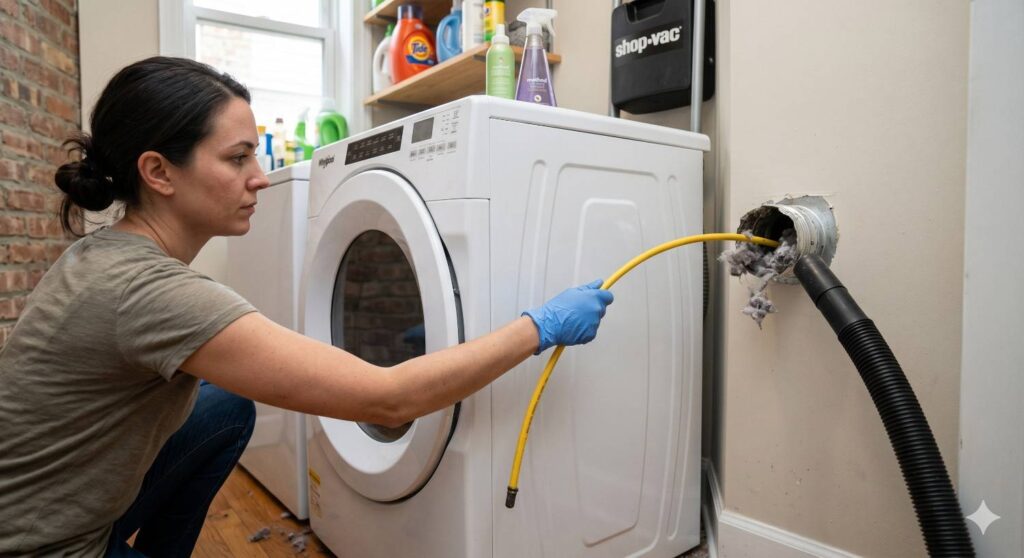
Yes, you can clean a dryer vent without removing the dryer — and in most homes, it’s the standard approach. By accessing the vent from behind the appliance or through the exterior vent cap, you can clear lint buildup, restore airflow, and reduce fire risk without ever pulling the dryer away from the wall.
That matters because a clogged dryer vent is one of the most overlooked fire hazards in a home, and most homeowners don’t realize cleaning it doesn’t require a full appliance move.
This guide covers the tools you need, a clear step-by-step process, the honest limits of DIY cleaning, and when a professional service is the smarter call.
Yes, You Can — Here’s What That Actually Means
In most homes, cleaning a dryer vent without removing the dryer is entirely practical. The vent duct — the tube that carries hot, moist air and lint from your dryer to the outside — connects to the back of the appliance with a clamp or friction fit. You can disconnect that connection, insert a cleaning brush, and work through the duct without ever shifting the dryer from its position.
What this approach does require is enough clearance behind the dryer to reach the vent hose connection — typically six to twelve inches. In most laundry rooms, that space already exists. If your dryer is built into a tight alcove with no rear access, you may need to pull it forward slightly, but that’s the exception rather than the rule.
For homeowners researching their options, the dryer vent cleaning service at AirDuctVet handles both DIY-accessible and hard-to-reach configurations — including long duct runs and multi-bend systems that standard brush kits can’t fully clear.
What “Cleaning Without Removing the Dryer” Really Involves
This method focuses on two access points: the vent connection at the back of the dryer and the exterior vent cap where air exits the home. You insert a flexible brush from one end, push it through the duct, and pull lint out from both sides. The dryer stays in place throughout. What changes is how thoroughly you can clean — and that depends heavily on duct length, the number of bends, and the tools you use.
Tools You Need to Clean a Dryer Vent Without Moving the Dryer
Having the right equipment makes the difference between a surface clean and a genuinely effective one. The good news is that the core tools are inexpensive and widely available at hardware stores.
Dryer Vent Cleaning Brush Kits
A flexible brush kit is the primary tool for this job. These kits include a long, flexible rod — typically in sections that connect together — with a lint brush head at one end. Quality kits extend to twelve feet or more, which covers most residential duct runs. Look for kits with a drill attachment option; connecting the rod to a power drill allows the brush to rotate as it moves through the duct, dislodging lint far more effectively than manual pushing alone.
Vacuum Attachments and Leaf Blowers
A shop vacuum with a hose attachment is essential for pulling loosened lint out of the duct opening and cleaning the area around the exterior vent cap. Some homeowners use a leaf blower to push lint out through the exterior opening — this works reasonably well on short, straight duct runs, but it can compact lint deeper into bends on longer or more complex systems. For most homes, the brush kit combined with a vacuum gives the most controlled and complete result.
Step-by-Step: How to Clean Your Dryer Vent Without Removing the Dryer
This process works for most standard residential dryer vent configurations. If your duct run exceeds fifteen feet or includes more than two ninety-degree bends, a professional cleaning is likely more effective than DIY.
Step 1 — Disconnect and Access the Vent
Unplug the dryer from the electrical outlet. If you have a gas dryer, turn off the gas supply valve. Reach behind the dryer and locate the vent hose — the flexible or rigid duct connecting the dryer exhaust port to the wall. Loosen the hose clamp or pull the friction-fit connection free. Set the hose aside. You now have direct access to both the dryer’s exhaust port and the wall duct opening.
Step 2 — Insert the Brush and Work Through the Duct
Attach your flexible brush rod sections together to match the length of your duct run. Insert the brush head into the wall duct opening and push it forward in a slow, rotating motion. If using a drill attachment, set it to low speed. Work the brush back and forth in short strokes to break up lint deposits as you advance. Pull the brush back out slowly, collecting loosened lint as you go. Use your shop vacuum to clear lint from the duct opening and the dryer’s exhaust port.
Step 3 — Clear the Exterior Vent Cap
Go outside and locate the exterior vent cap — typically a louvered or flap-style cover on an exterior wall. Remove the cover if it detaches, or clean around the flaps with a brush. Use your vacuum to remove any lint accumulated at the opening. Check that the flaps open and close freely; stuck or lint-clogged flaps restrict airflow even after the duct itself is clean. Reattach the vent hose inside, secure the clamp, plug the dryer back in, and run it on air-only for ten minutes to confirm airflow has improved.
What DIY Dryer Vent Cleaning Can and Cannot Do
DIY cleaning is genuinely useful for routine maintenance on short, straight duct runs. It removes surface lint, improves airflow, and reduces the risk of minor blockages developing into serious ones. For many homeowners doing annual maintenance on a standard setup, it’s a reasonable approach.
The limitation is scope. A standard brush kit cleans what it can physically reach and rotate through. Duct runs longer than twelve to fifteen feet, systems with multiple bends, or vents that transition from flexible to rigid duct mid-run all create areas where lint compacts in ways a consumer brush kit cannot fully address.
The Limitations That Put Your Home at Risk
Deep lint blockages — the kind that form over years of use in longer duct systems — don’t always produce obvious warning signs until they’re severe. A DIY clean can remove the accessible lint while leaving a compacted mass further down the duct. That partial clean can actually create a false sense of security: the dryer seems to run better, but the underlying blockage remains. How clogged dryer vents cause fires <!–NEW PAGE NEEDED–> is a risk that compounds quietly, which is why understanding the limits of what a brush kit can reach matters as much as knowing how to use one.
Warning Signs Your Dryer Vent Needs Immediate Attention
These signs indicate a vent that needs cleaning now — not at the next scheduled maintenance interval:
Clothes take more than one cycle to dry fully. This is the most common and reliable indicator. Restricted airflow means moisture can’t escape efficiently, so drying times increase noticeably.
The dryer exterior feels unusually hot during operation. A properly vented dryer exhausts heat outward. When that path is blocked, heat builds up inside the appliance and radiates through the cabinet.
You notice a burning smell during or after a cycle. Lint is highly flammable. A burning odor during operation is a serious warning that lint may be in contact with the heating element or exhaust components.
Lint is visible around the exterior vent opening. If lint is escaping around the vent cap rather than through it, the duct is likely too restricted to move air properly.
The laundry room feels more humid than usual. Moisture that can’t exhaust through the vent stays in the room. Persistent humidity in the laundry area after running the dryer points to a blocked or disconnected vent.
The dryer shuts off mid-cycle. Most modern dryers have thermal overload protection that cuts power when internal temperatures exceed safe limits. Repeated mid-cycle shutoffs are a direct signal of heat buildup from restricted airflow.
If you’re seeing any of these signs, a professional dryer vent inspection is the appropriate next step — not another DIY attempt.
Why Professional Dryer Vent Cleaning Goes Further
DIY cleaning handles routine maintenance. Professional cleaning handles everything else. The difference isn’t just equipment — it’s the ability to assess, diagnose, and fully clear a vent system regardless of its length, configuration, or contamination level.
What a Professional Service Includes That DIY Misses
A professional dryer vent cleaning uses rotary brush systems driven by high-powered equipment that maintains consistent rotation and suction through the full duct length — including bends and transitions that consumer kits can’t navigate effectively. Technicians measure airflow before and after cleaning to confirm the duct is fully clear, not just partially improved. Many professional services also include a visual inspection of the duct connection, the exterior cap, and the vent hose for damage, disconnections, or improper materials that create ongoing risk.
For homeowners in the area, dryer vent cleaning in Alexandria, VA through AirDuctVet includes a full-length duct clean, exterior cap inspection, and airflow verification — the complete service, not just a brush pass. Technicians also note whether connected systems like air duct cleaning may benefit from attention, since HVAC and dryer vent systems often share the same service visit efficiently.
Understanding how much dryer vent cleaning costs <!–NEW PAGE NEEDED–> helps homeowners budget for this service and compare providers with confidence — pricing typically ranges from $89 to $175 for a standard residential vent, depending on duct length and accessibility.
How Often Should You Clean Your Dryer Vent?
The standard recommendation from the National Fire Protection Association is to clean dryer vents at least once per year. That baseline applies to a typical household running four to five loads of laundry per week with a standard duct run of eight to twelve feet.
Several variables push that frequency higher. Households with more than four people, those with pets that shed heavily, and homes with duct runs longer than fifteen feet or multiple bends should plan for cleaning every six months. The same applies if the dryer is used for heavy items like comforters, towels, or work clothing that generate more lint per cycle than standard laundry.
The simplest rule: if drying times are increasing between cleanings, the interval is too long. Schedule a dryer vent cleaning before performance degrades noticeably rather than waiting for a warning sign to appear.
For a complete breakdown of variables that affect cleaning frequency, how often to clean a dryer vent <!–NEW PAGE NEEDED–> covers household size, duct configuration, and usage patterns in full detail.
Conclusion
Cleaning a dryer vent without removing the dryer is practical, achievable, and the right starting point for routine annual maintenance. The right tools, a clear process, and honest awareness of DIY limits keep most households safe between professional visits.
When warning signs appear or duct length and configuration exceed what a brush kit can handle, professional cleaning closes the gap that DIY leaves open.
For complete dryer vent cleaning in Alexandria, VA — including full-length duct clearing, airflow verification, and exterior cap inspection — contact AirDuctVet Dryer & Vent Cleaning Services to schedule your service today.
Frequently Asked Questions
Can I clean my dryer vent myself without any special tools?
You can remove loose lint from the vent opening with a vacuum, but without a flexible brush kit, you cannot clean the full duct length. Basic vacuuming alone is not sufficient for a thorough clean.
How do I know if my dryer vent is clogged?
The most reliable signs are clothes taking longer than one cycle to dry, a burning smell during operation, and the dryer exterior feeling unusually hot. Visible lint around the exterior vent cap is also a clear indicator.
Is it safe to use a leaf blower to clean a dryer vent?
A leaf blower can push lint out of short, straight duct runs effectively. On longer runs with bends, it risks compacting lint deeper into the duct rather than clearing it, which can worsen the blockage.
How long does it take to clean a dryer vent without moving the dryer?
A DIY clean on a standard duct run typically takes thirty to forty-five minutes. Professional cleaning, including inspection and airflow verification, generally takes forty-five to sixty minutes for a residential vent.
What happens if I never clean my dryer vent?
Lint accumulates until airflow is severely restricted, causing longer drying times, increased energy use, appliance wear, and — in serious cases — a dryer vent fire. According to the NFPA, failure to clean is the leading factor in home dryer fires.
How much does professional dryer vent cleaning cost in Alexandria, VA?
Professional dryer vent cleaning in Alexandria, VA typically ranges from $89 to $175 for a standard residential vent. Longer duct runs, difficult access points, or heavily compacted lint may affect the final price.
Can a clogged dryer vent cause a fire?
Yes. Lint is highly flammable, and a blocked vent traps heat inside the duct and appliance. The NFPA reports that dryers and washing machines account for approximately 13,820 home fires annually, with failure to clean the vent as the leading contributing factor.
