Professional carpet cleaning consistently outperforms DIY methods in results quality, soil extraction depth, and drying efficiency — and when you factor in the true cost of renting equipment, buying solutions, and investing your time, the price gap between the two options is often smaller than most homeowners expect.
The choice between hiring a professional and doing it yourself affects more than just how your carpets look. It influences how long they last, how clean your indoor air actually is, and whether you risk mold growth from improper moisture extraction.
This guide breaks down the real equipment differences, honest cost comparisons for Alexandria, VA homeowners, health implications, and exactly when each option makes sense — so you can make a confident, informed decision.
What Is the Real Difference Between Professional and DIY Carpet Cleaning?
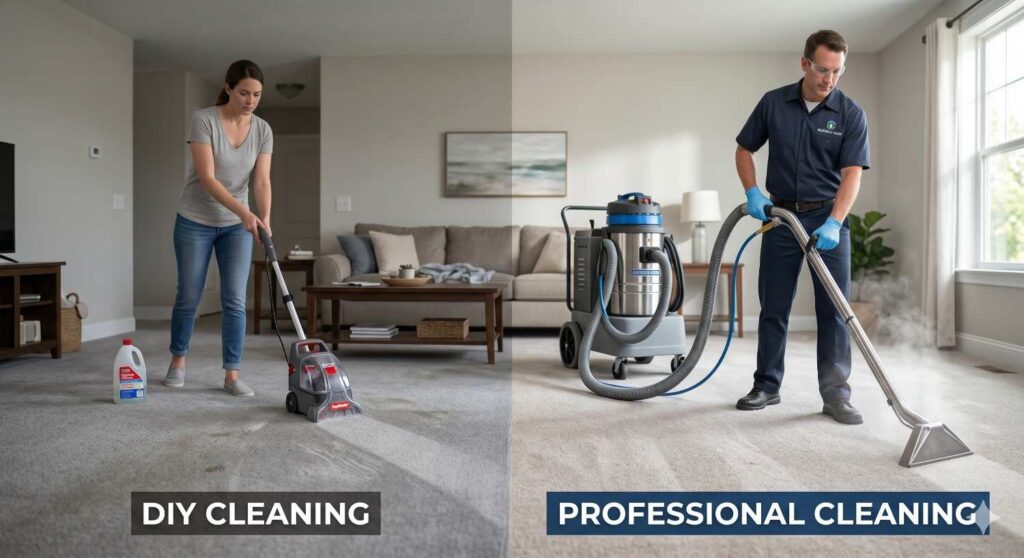
The core difference between professional and DIY carpet cleaning comes down to three things: the power of the equipment, the quality of the cleaning solutions, and the technical knowledge applied during the process. Consumer rental machines and store-bought products are designed for accessibility, not performance. Professional systems are engineered for results.
Equipment: Truck-Mounted Systems vs. Consumer Rental Machines
Professional carpet cleaners use truck-mounted hot water extraction systems — the industry standard for deep cleaning. These machines generate water temperatures between 200°F and 230°F and deliver water pressure exceeding 500 PSI, which suspends and lifts soil from deep within carpet fibers and backing. Equally important, their suction power extracts the vast majority of that moisture immediately, leaving carpets damp rather than saturated.
Consumer rental units available at grocery stores and home improvement centers operate at a fraction of that capacity. Most portable rental machines produce water temperatures below 120°F and significantly lower pressure, which means they agitate surface soil without fully suspending the deeper layers. Their extraction motors are also considerably weaker, leaving substantially more moisture behind in the carpet and padding.
The practical result is straightforward: professional equipment reaches soil that rental machines simply cannot. A truck-mounted system cleaning a heavily trafficked living room will extract embedded grit, allergens, and organic matter that a rental unit will redistribute rather than remove.
Cleaning Solutions: Industrial-Grade vs. Store-Bought Products
Professional carpet cleaners use pH-balanced, enzyme-based, and surfactant-formulated solutions calibrated to specific carpet fiber types and soil conditions. These solutions are designed to break down organic matter, suspend soil particles, and rinse completely out of the carpet — leaving no residue behind.
Store-bought carpet shampoos and rental machine solutions are formulated for general consumer use. Many contain higher concentrations of surfactants that clean effectively on the first pass but leave a sticky detergent residue in the carpet fibers. That residue acts like a magnet for new soil, which is why carpets cleaned with consumer products often look dirty again within weeks — a phenomenon known as resoiling.
This is one of the least-discussed but most consequential differences between the two approaches. A carpet that resoils rapidly after DIY cleaning is not just a cosmetic problem — it means the cleaning cycle shortens, costs increase over time, and the carpet ages faster than it should.
How Do the Results Actually Compare?
On a surface level, both professional cleaning and a thorough DIY effort will improve the appearance of a carpet. The meaningful difference emerges when you look at what happens below the surface — in the deeper soil layers, the carpet backing, and the padding underneath.
Stain Removal and Deep Soil Extraction
Professional technicians apply targeted pre-treatment solutions to set-in stains before the main cleaning pass. Enzyme-based pre-treatments break down organic stains — pet urine, food, and biological matter — at the molecular level before extraction begins. Oxidizing agents handle tannin-based stains like coffee and red wine. This pre-treatment step, combined with the agitation brush and high-pressure extraction that follows, gives professional cleaning a meaningful advantage on stains that have had time to bond with carpet fibers.
How often should carpets be professionally cleaned to prevent stains from setting permanently? <!–NEW PAGE NEEDED–>
DIY cleaning with rental equipment can address fresh spills and light surface soiling reasonably well. However, set-in stains — particularly pet urine that has penetrated into the carpet backing and padding — are beyond what consumer equipment can fully address. The lower water temperature and pressure cannot fully activate pre-treatment chemistry, and the weaker extraction leaves contaminated moisture behind rather than removing it.
It is worth noting that no cleaning method, professional or otherwise, guarantees complete removal of every stain. Stains that have been heat-set (from steam irons or hot water applied incorrectly), chemically altered by bleach-based cleaners, or allowed to bond with synthetic fibers for extended periods may be permanent. A reputable professional will tell you this upfront rather than overpromising.
Drying Time and the Risk of Over-Wetting
Professionally cleaned carpets typically dry within two to six hours under normal conditions, with good ventilation. The high-powered extraction of truck-mounted systems removes the majority of the cleaning water during the process itself, leaving carpets damp rather than wet.
Rental machines leave significantly more moisture in the carpet and padding. Drying times of 12 to 24 hours are common, and in humid conditions or poorly ventilated rooms, carpets can remain damp for 48 hours or longer. This extended moisture window creates a genuine risk of mold and mildew growth — not just on the carpet surface, but in the carpet padding and potentially the subfloor beneath it.
Mold growth in carpet padding is particularly problematic because it is invisible until the contamination is severe, and by that point the padding typically requires replacement. Over-wetting from a DIY cleaning attempt can turn a routine maintenance task into a costly remediation project. Opening windows, running fans, and using a dehumidifier after DIY cleaning reduces this risk but does not eliminate it.
What Does Professional Carpet Cleaning Actually Cost in Alexandria, VA?
What does a professional carpet cleaning service actually include? <!–NEW PAGE NEEDED–>
Cost is the primary reason most homeowners consider DIY carpet cleaning in the first place. Understanding what you actually pay — in both scenarios — is essential to making a sound decision.
Average Professional Pricing Ranges
In Alexandria, VA, professional carpet cleaning typically ranges from $25 to $75 per room, with most standard-sized bedrooms and living rooms falling between $35 and $55. Whole-home cleaning for a three-bedroom house generally runs between $150 and $300, depending on total square footage, carpet condition, and the specific services included.
Pricing factors that affect the final cost include the level of soiling (heavily soiled carpets require more time and solution), the presence of pet stains or odors (which require enzyme pre-treatment), the accessibility of the space, and any add-on services such as carpet protector application or deodorizer treatment. Most reputable companies in the Alexandria area provide written estimates before beginning work, and pricing should be clearly itemized rather than quoted as a vague “per room” figure without defining room size.
Be cautious of advertised prices significantly below these ranges — particularly offers of whole-home cleaning for $49 or $99. These are frequently bait-and-switch pricing structures where the base price covers only a surface rinse, with aggressive upsells for pre-treatment, deodorizing, and protector that bring the final invoice to market rate or above.
The True Cost of DIY Carpet Cleaning
The apparent cost of DIY carpet cleaning is the rental fee — typically $35 to $50 per day for a standard upright carpet cleaner from a home improvement store or grocery chain. But the true cost is higher once you account for all the variables.
Cleaning solution for a full home rental typically costs an additional $20 to $40, depending on the brand and the number of rooms. Transportation to and from the rental location, the time investment (a full home typically takes four to six hours including furniture moving, cleaning passes, and waiting for drying), and the physical effort involved all add to the real cost. If the results are unsatisfactory — which is common with heavily soiled carpets or set-in stains — a second rental pass adds another $55 to $90 to the total.
Is a professional carpet cleaning vs. rental machine comparison worth running for your specific home size? <!–NEW PAGE NEEDED–>
When you add rental fee, solution, transportation, and time at a conservative hourly value, a DIY cleaning of a three-bedroom home often costs $120 to $200 in real terms — before accounting for any risk of carpet damage or the need for repeat cleaning. The gap between DIY and professional service is frequently $50 to $100, not the $150 to $200 that the rental fee alone suggests.
What Are the Health and Indoor Air Quality Implications?
Carpets function as a passive filtration system in your home. They trap dust, pollen, pet dander, dust mite debris, and other airborne particulates that would otherwise remain suspended in the air you breathe. This is actually beneficial — until the carpet reaches its holding capacity and begins releasing those particles back into the air with every footstep.
How Carpet Cleaning Connects to Your Home’s Overall Air Quality
When foot traffic disturbs a heavily loaded carpet, it redistributes trapped allergens and particulate matter back into the breathing zone. According to the EPA, indoor air can be two to five times more polluted than outdoor air, and carpet-trapped allergens are a significant contributor in homes with pets, high foot traffic, or inadequate ventilation.
Professional hot water extraction removes not just visible soil but the biological load embedded in carpet fibers — dust mite debris, pet dander, pollen, and mold spores. This directly reduces the allergen reservoir that carpets accumulate over time, which is particularly meaningful for households with allergy sufferers, asthma patients, or young children who spend time on the floor.
The connection between carpet cleanliness and whole-home air quality extends beyond the carpet itself. Contaminated carpets contribute to the particulate load that circulates through your HVAC system, eventually settling in air ducts and reducing the efficiency of your filtration. Professional air duct cleaning addresses the duct side of this equation, but maintaining clean carpets reduces the rate at which ducts accumulate that contamination in the first place. For a comprehensive approach to improving your home’s indoor air quality, addressing both carpet cleanliness and duct hygiene together produces the most meaningful results.
When Should You Hire a Professional Carpet Cleaner?
The honest answer is that professional cleaning is the right choice for most situations involving anything beyond a fresh, isolated spill. The question is not really whether professional cleaning is better — it is whether the specific situation justifies the cost.
Situations Where DIY Is Simply Not Enough
Pet urine contamination is the clearest case where professional cleaning is necessary rather than optional. Urine that has penetrated carpet backing and padding cannot be fully addressed by rental equipment. The odor-causing bacteria and uric acid crystals require enzyme-based pre-treatment and high-temperature extraction to neutralize — conditions that consumer machines cannot reliably achieve.
Heavy soiling in high-traffic areas — hallways, living rooms, stairs — accumulates compacted soil that bonds with carpet fibers over time. This type of soiling requires the combination of professional pre-treatment, agitation, and high-pressure extraction to fully release. Rental machines will improve the appearance temporarily but will not achieve the same depth of cleaning.
Landlords and property managers preparing a rental unit for turnover, or homeowners preparing a home for sale, should always use professional cleaning. The results are visibly superior, the drying time is shorter (reducing the delay before the space is usable), and the documentation of professional service can be relevant in security deposit disputes. For a complete picture of what this involves, carpet cleaning for rental properties <!–NEW PAGE NEEDED–> covers the landlord-specific considerations in detail.
Allergy management, post-renovation dust removal, and any situation involving visible mold, significant odor, or water damage also fall clearly into the professional category. In these cases, the health and structural stakes are too high for consumer equipment to address adequately.
For broader home maintenance, pairing carpet cleaning with dryer vent cleaning and air duct service as part of an annual home health routine addresses multiple indoor air quality factors simultaneously.
When DIY Spot Cleaning Is Acceptable
Fresh spills are the primary situation where immediate DIY response is not just acceptable but recommended. Blotting a fresh liquid spill with a clean cloth — working from the outside of the stain inward, never rubbing — and applying a small amount of enzyme cleaner can prevent a spill from becoming a set-in stain. Acting within the first few minutes dramatically improves the outcome.
Light surface maintenance between professional cleanings — vacuuming regularly, treating isolated fresh spots, and using entrance mats to reduce tracked-in soil — is entirely appropriate as a DIY activity. The key distinction is between maintenance and deep cleaning. DIY methods are effective for the former; professional service is necessary for the latter.
How to Choose a Trustworthy Carpet Cleaning Company in Alexandria, VA
The carpet cleaning industry has a well-documented history of misleading pricing and aggressive upselling. Knowing what to look for protects you from both poor results and unnecessary charges.
How to choose a carpet cleaning company that won’t upsell you <!–NEW PAGE NEEDED–> is a question worth researching before you book. The most important credential to look for is IICRC certification — the Institute of Inspection Cleaning and Restoration Certification. IICRC-certified technicians have completed standardized training in cleaning methods, fiber types, and moisture management. Certification does not guarantee quality, but its absence is a meaningful red flag.
Ask specifically whether the company uses truck-mounted hot water extraction or portable equipment. Truck-mounted systems consistently outperform portables for residential deep cleaning. Ask for a written, itemized estimate before work begins, and confirm what is included in the base price versus what triggers additional charges.
Check Google reviews and the Better Business Bureau for the Alexandria, VA area. Pay particular attention to reviews that mention pricing surprises, drying time problems, or resoiling within weeks of cleaning — these are the most reliable indicators of service quality. Companies serving Alexandria, VA homeowners with transparent pricing and clear service descriptions are the ones worth booking.
Avoid any company that quotes a whole-home price significantly below market rate without a clear explanation of what is included. The bait-and-switch model is common enough in this industry that an unusually low quote should prompt questions, not excitement.
How to Maintain Your Carpets Between Professional Cleanings
The interval between professional cleanings matters as much as the cleaning itself. Most carpet manufacturers and cleaning professionals recommend professional cleaning every 12 to 18 months for average households, and every 6 to 12 months for homes with pets, children, or allergy sufferers. How often carpets should be professionally cleaned <!–NEW PAGE NEEDED–> depends on several household-specific factors, but consistent maintenance between appointments extends the life of each professional cleaning significantly.
Vacuuming is the single most effective maintenance activity. A HEPA-filter vacuum used two to three times per week in high-traffic areas removes the surface soil and particulate matter before it has a chance to work deeper into the carpet fibers. Vacuuming slowly — two passes in each direction — extracts significantly more soil than a quick single pass.
Entrance mats at every exterior door reduce the volume of tracked-in soil by a meaningful margin. A no-shoes policy inside the home amplifies this effect further. These two habits alone can extend the interval between professional cleanings and keep carpets looking cleaner between appointments.
When spills happen, respond immediately. Blot — never rub — and use an enzyme-based cleaner appropriate for the carpet fiber type. Avoid applying excessive water, which risks the same over-wetting problems associated with rental machine misuse. For guidance on maintaining your home’s overall air quality <!–NEW PAGE NEEDED–> alongside carpet care, consistent vacuuming and prompt spill response are the foundation of a practical home maintenance routine.
Conclusion
Professional carpet cleaning delivers measurably better results than DIY methods across every meaningful metric — soil extraction depth, stain removal, drying time, and long-term carpet health. The true cost difference between the two options is smaller than most homeowners assume once all DIY expenses are honestly accounted for.
Clean carpets are not just a cosmetic concern. They directly affect the allergen load in your home’s air, the performance of your HVAC system, and the long-term condition of one of your home’s most significant surface investments.
At AirDuctVet Dryer & Vent Cleaning Services, we help Alexandria, VA homeowners build a complete picture of their indoor environment — contact us today to learn how professional cleaning services protect both your home and the air your family breathes.
Frequently Asked Questions
How often should carpets be professionally cleaned?
Most carpets benefit from professional cleaning every 12 to 18 months. Homes with pets, children, or allergy sufferers should schedule cleaning every 6 to 12 months to manage allergen buildup and maintain carpet condition.
Is renting a carpet cleaner worth it?
For light surface maintenance or a single fresh stain, a rental machine can be adequate. For whole-home deep cleaning, the true cost — rental fee, solution, time, and repeat-cleaning risk — often comes within $50 to $100 of professional service, making professional cleaning the better value in most cases.
Can professional carpet cleaning remove all stains?
Professional cleaning removes the vast majority of stains, including set-in pet stains, food, and organic matter. Stains that have been heat-set, chemically altered by bleach, or bonded with synthetic fibers over years may be permanent. A reputable technician will assess and advise honestly before cleaning begins.
How long does it take for professionally cleaned carpets to dry?
Professionally cleaned carpets typically dry within two to six hours with normal ventilation. Rental machine cleaning can leave carpets damp for 12 to 48 hours, depending on humidity and airflow — creating a meaningful mold risk if ventilation is inadequate.
Does DIY carpet cleaning damage carpets?
DIY cleaning can damage carpets through over-wetting, which saturates padding and risks mold growth, and through detergent residue from consumer solutions, which accelerates resoiling and can degrade carpet fibers over time. Using too much water or the wrong solution for the carpet fiber type are the most common causes of DIY damage.
Is professional carpet cleaning worth the cost?
For most households, yes. Professional cleaning extends carpet life, removes allergens that consumer equipment cannot reach, and produces results that last significantly longer than DIY cleaning. When the true cost of DIY is calculated honestly, the value gap between the two options is smaller than the rental fee alone suggests.
How does carpet cleaning affect indoor air quality?
Carpets trap dust, pollen, pet dander, and dust mite debris. When that load exceeds the carpet’s capacity, foot traffic redistributes those particles into the air. Professional extraction removes the biological load from carpet fibers, directly reducing the allergen concentration in your home’s breathing zone and lowering the particulate burden on your HVAC system.

