
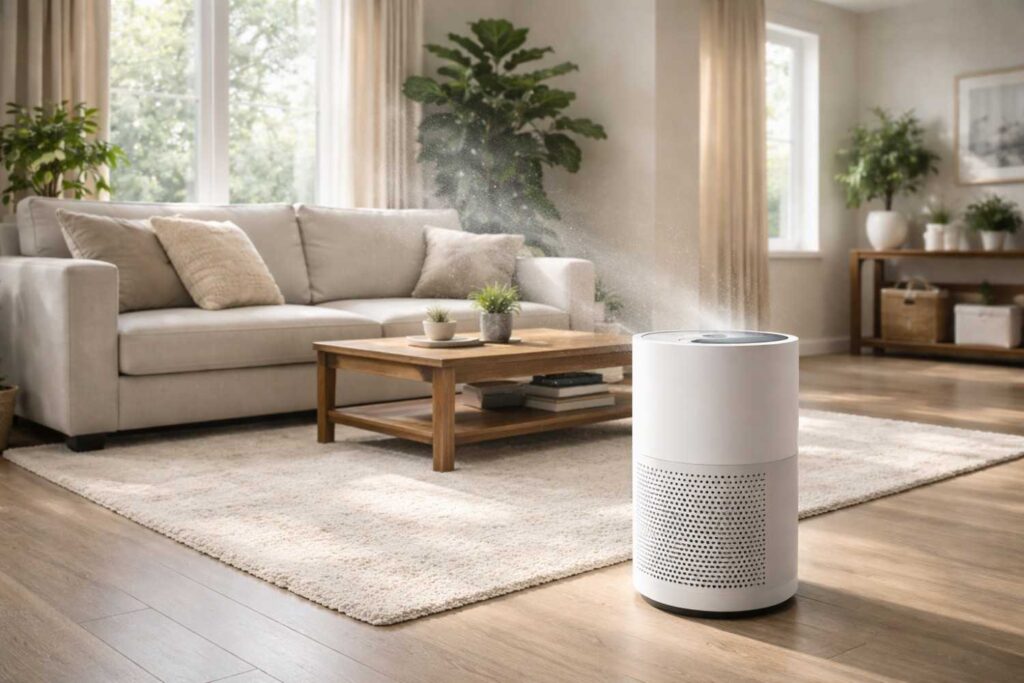
Most air purifiers need between 30 minutes and 2 hours to noticeably reduce dust in a single room. The exact timeline depends on room size, filter type, CADR rating, and how much dust is already circulating.
But here is what most guides will not tell you: if dust keeps coming back no matter how long your purifier runs, the source may be inside your air ducts, not just floating in the room. This guide breaks down realistic timelines by room size, explains the factors that speed up or slow down dust removal, and shows you when professional duct cleaning is the smarter long-term fix for Alexandria, VA homeowners.
How Long Does an Air Purifier Take to Clean a Room?
The time it takes an air purifier to remove dust depends primarily on the room’s square footage and the unit’s Clean Air Delivery Rate (CADR). CADR measures how many cubic feet of clean air the purifier produces per minute. A higher CADR means faster dust removal.
Here is a general breakdown by room size, assuming a standard ceiling height of 8 feet and a purifier properly rated for the space.
Small Rooms (Up to 200 Sq Ft)
Bedrooms, home offices, and nurseries in this size range typically see noticeable dust reduction within 30 to 45 minutes. A purifier with a dust CADR of at least 100 CFM can cycle the air in a 200-square-foot room roughly every 15 to 20 minutes.
For Alexandria, VA homes with older construction, small rooms tend to accumulate dust faster due to aging window seals and proximity to exterior walls. Running the purifier continuously on a medium setting keeps particle levels consistently low.
Medium Rooms (200 to 400 Sq Ft)
Living rooms and master bedrooms in this range need approximately 45 minutes to 1.5 hours for a meaningful reduction in airborne dust. You will want a purifier with a dust CADR of at least 200 CFM to handle this volume efficiently.
Placing the unit in the center of the room or near the primary dust source (like a window or HVAC vent) speeds up the process. Closing doors and windows during the initial cleaning cycle also helps the purifier work without competing against new dust entering the space.
Large or Open-Plan Spaces (400+ Sq Ft)
Open-concept living areas, finished basements, and great rooms require 1.5 to 3 hours or more, depending on the purifier’s capacity. Many standard consumer units are not rated for spaces above 500 square feet, which means the purifier may never fully catch up with dust generation in the room.
For spaces this large, consider either a commercial-grade unit with a dust CADR above 300 CFM or multiple smaller units positioned strategically. In many Alexandria homes with open floor plans, a single portable purifier simply cannot process enough air volume to make a lasting difference.
What Factors Affect How Quickly an Air Purifier Removes Dust?
Room size is the most obvious variable, but several other factors determine whether your purifier clears dust in 30 minutes or 3 hours.
Room Size and Ceiling Height
Most CADR ratings assume an 8-foot ceiling. If your Alexandria home has 9- or 10-foot ceilings (common in newer construction and renovated townhomes), the actual air volume is significantly larger than the square footage suggests. A 300-square-foot room with 10-foot ceilings contains 3,000 cubic feet of air instead of 2,400. That is a 25% increase in air volume your purifier needs to process.
CADR Rating and Filter Type
CADR is the single most important specification for dust removal speed. The Association of Home Appliance Manufacturers (AHAM) certifies CADR ratings through standardized testing. Look for three separate CADR numbers on any purifier: one for dust, one for smoke, and one for pollen. The dust CADR is what matters here.
A general rule: your purifier’s dust CADR should be at least two-thirds of your room’s square footage. A 300-square-foot room needs a minimum dust CADR of 200 CFM.
Air Changes Per Hour (ACH)
ACH measures how many times the purifier can filter the entire volume of air in a room within one hour. For dust removal, you want a minimum of 4 ACH, meaning the full room volume gets filtered four times per hour. Allergy sufferers and homes with pets benefit from 5 to 6 ACH.
You can calculate ACH yourself: multiply the CADR by 60, then divide by the room’s cubic footage (length x width x ceiling height). If the result is below 4, the purifier is undersized for that room.
Dust Concentration and Contamination Level
A room that has not been cleaned in weeks will take significantly longer to purify than one with light, everyday dust. Heavy contamination from renovation work, pet dander buildup, or a home that has been closed up for an extended period can double or triple the initial cleaning time.
In Alexandria, seasonal factors also play a role. Spring pollen season and summer humidity increase particulate loads. Homes near construction zones along the Route 1 corridor or in Old Town’s historic district often deal with elevated dust from nearby development activity.
Placement and Airflow Obstructions
Placing a purifier in a corner, behind furniture, or on the floor against a wall reduces its effectiveness by restricting airflow. The unit needs clear space on all sides, ideally at least 3 feet from walls and large objects.
Elevating the purifier on a table or shelf (roughly 3 to 5 feet off the ground) can improve performance because most dust particles circulate in the middle zone of a room, not at floor level.
HEPA Filters vs. Other Filter Types for Dust Removal
Not all air purifiers use the same filtration technology, and the filter type directly affects how quickly and thoroughly dust gets removed.
True HEPA Filters
True HEPA (High-Efficiency Particulate Air) filters capture 99.97% of particles as small as 0.3 microns. This includes fine dust, pollen, mold spores, and pet dander. For dust removal specifically, True HEPA is the gold standard.
The key distinction is “True HEPA” versus “HEPA-type” or “HEPA-style” filters. Only True HEPA meets the Department of Energy’s filtration standard. HEPA-type filters may capture as little as 85% to 90% of particles, which means significantly more dust passes through and recirculates.
Ionic and Electrostatic Purifiers
Ionizers release charged particles that attach to dust, causing it to settle on surfaces rather than remain airborne. This can make the air feel cleaner, but the dust is not actually removed from the room. It lands on your furniture, floors, and walls instead.
Electrostatic precipitators work similarly by charging particles and collecting them on metal plates inside the unit. They can be effective for larger particles but typically underperform compared to HEPA filters for fine dust. Some ionic purifiers also produce trace amounts of ozone, which is a concern for indoor air quality.
Activated Carbon Filters
Activated carbon excels at removing odors, volatile organic compounds (VOCs), and chemical fumes. However, carbon filters do very little for particulate dust. Most quality air purifiers combine a HEPA filter with an activated carbon layer, giving you both particle and gas-phase filtration.
If your primary concern is dust, prioritize the HEPA filter’s quality and CADR rating over the carbon filter’s size.
How to Tell If Your Air Purifier Is Actually Working
Running a purifier for hours means nothing if you cannot verify it is making a difference. Here is how to check.
Visual and Physical Signs
Within the first 24 to 48 hours of continuous operation, you should notice less dust settling on flat surfaces like shelves, TV screens, and countertops. If you normally wipe surfaces daily and still see a film of dust, the purifier may be undersized or poorly positioned.
Check the filter itself after one to two weeks of use. A working HEPA filter will show visible gray discoloration from trapped particles. If the filter looks brand new after weeks of operation, the unit may not be drawing enough air.
Using an Air Quality Monitor
For precise measurement, a standalone air quality monitor that tracks PM2.5 (fine particulate matter) gives you real numbers. Baseline your room’s PM2.5 level before turning on the purifier, then check again after 1 hour and 4 hours.
A well-functioning purifier in a properly sized room should reduce PM2.5 levels by 50% or more within the first hour and reach near-outdoor-clean levels within 2 to 4 hours. If levels barely change, something is wrong with the unit, the filter, or the room’s dust source.
Why Your Air Purifier Might Not Be Removing Dust Fast Enough
If your purifier has been running for days and dust is still a persistent problem, one of these issues is likely the cause.
Dirty or Clogged Filters
HEPA filters have a finite lifespan, typically 6 to 12 months depending on usage and dust levels. A clogged filter restricts airflow dramatically, reducing the effective CADR to a fraction of its rated capacity. Some purifiers have filter replacement indicators, but many do not. Check your filter manually every 3 months.
Undersized Unit for the Room
This is the most common mistake homeowners make. A purifier rated for 150 square feet will barely make a dent in a 400-square-foot living room. Always match the purifier’s rated room size to your actual space, and when in doubt, size up.
Dust Source Is in Your Ductwork
This is the factor most air purifier guides completely ignore. If your HVAC system’s ductwork contains accumulated dust, debris, pet hair, or construction residue, every time your heating or cooling system cycles on, it pushes that contamination directly into your living space.
No portable air purifier can keep up with a forced-air HVAC system blowing dust from dirty ducts into every room simultaneously. The purifier filters a few hundred cubic feet per minute while your HVAC system moves 1,000 to 2,000 CFM through contaminated ductwork. The math does not work in the purifier’s favor.
For Alexandria homeowners dealing with persistent dust despite running air purifiers, dirty ductwork is one of the most common and most overlooked root causes.
How Dirty Air Ducts Affect Indoor Dust Levels in Alexandria, VA
Alexandria’s housing stock ranges from historic homes in Old Town built in the 1800s to modern construction in the West End and Kingstowne. Each comes with unique duct contamination challenges.
Common Dust Sources in Alexandria Homes
Older homes in Del Ray, Rosemont, and Old Town often have original or aging ductwork that has accumulated decades of dust, insulation particles, and debris. Renovations in these neighborhoods frequently disturb settled contaminants without proper duct sealing afterward.
Newer homes and townhomes in areas like Potomac Yard and Eisenhower Valley may have construction dust still trapped in ductwork from the building phase. Drywall dust, sawdust, and insulation fibers from initial construction can circulate for years if the ducts were never cleaned after the build.
Alexandria’s proximity to the Potomac River also means higher humidity levels for much of the year, which can cause dust to clump and adhere to duct interiors, creating a persistent contamination layer that normal HVAC airflow alone will not dislodge.
When Air Duct Cleaning Makes More Sense Than an Air Purifier Alone
An air purifier treats symptoms. Duct cleaning addresses the source. If any of these apply to your situation, professional duct cleaning will likely do more for your dust problem than adding another purifier:
- Dust returns within a day or two of cleaning surfaces, even with a purifier running
- You have never had your ducts cleaned, or it has been more than 5 years
- Recent renovations or construction work occurred in or near your home
- You notice dust blowing from supply vents when the HVAC system kicks on
- Multiple household members experience allergy symptoms or respiratory irritation
- You have pets that shed, and dander circulates despite regular cleaning
In many cases, the most effective approach combines professional duct cleaning to eliminate the source with a properly sized air purifier to maintain ongoing air quality.
What Professional Air Duct Cleaning Includes and What It Costs
Understanding what a legitimate duct cleaning service involves helps you budget accurately and avoid companies that cut corners or inflate prices with unnecessary add-ons.
Typical Pricing Ranges for Alexandria, VA
For a standard residential home in Alexandria with a single HVAC system, professional air duct cleaning typically costs between $300 and $500. This range covers most homes with 8 to 15 supply vents and standard ductwork configurations.
Factors that push pricing higher include:
- Multiple HVAC systems: Homes with 2 or more systems can expect costs of $500 to $800+
- Extensive contamination: Heavy mold, vermin evidence, or post-construction debris may require additional treatment
- Access difficulty: Ductwork in tight crawl spaces, complex attic configurations, or commercial properties with long duct runs
- Add-on services: Dryer vent cleaning (typically $100 to $175 additional) and sanitization treatments
Be cautious of companies advertising whole-house duct cleaning for $99 or similar prices that seem too good to be true. These offers typically cover only a fraction of the system or serve as a foot-in-the-door for aggressive upselling once the technician is inside your home.
What a Thorough Cleaning Service Should Cover
A professional, industry-standard duct cleaning should include:
- Inspection of the entire duct system before work begins, ideally with a camera
- Source removal cleaning using mechanical agitation (brushes, air whips) combined with negative air pressure from a truck-mounted or portable HEPA vacuum
- Cleaning of all supply and return vents, registers, and grilles
- Main trunk line cleaning for both supply and return sides
- Blower motor and housing cleaning to remove accumulated dust from the air handler
- Post-cleaning inspection to verify results, with before-and-after photos when possible
The National Air Duct Cleaners Association (NADCA) sets the industry standard for proper duct cleaning procedures. A reputable contractor follows these guidelines and can explain their process clearly before starting work.
How to Avoid Misleading Lowball Offers
The duct cleaning industry unfortunately attracts some operators who use deceptive pricing. Here is what to watch for:
Bait-and-switch pricing: An advertised price of $49 or $99 that suddenly becomes $400 to $800 once the technician “discovers” additional problems. Legitimate companies provide a clear estimate before work begins and stick to it.
Per-vent pricing traps: Some companies quote a low per-vent price but then count every opening in your system individually, including returns, supplies, and trunk connections. A 15-vent home at “$25 per vent” sounds reasonable until the final bill includes 30+ “vents.”
Unnecessary add-ons: Chemical treatments, antimicrobial coatings, and “sanitization” services are sometimes recommended when they are not needed. These can add $200 to $500 to your bill. A trustworthy contractor will only recommend treatments when there is a documented reason, such as visible mold growth confirmed by testing.
No equipment on site: Professional duct cleaning requires significant equipment, typically a truck-mounted vacuum system or a large portable HEPA vacuum unit. If a technician shows up with only a standard shop vacuum, the cleaning will not meet industry standards.
Conclusion
Most air purifiers reduce visible dust within 30 minutes to 2 hours, depending on room size, CADR rating, and contamination level. But if dust keeps returning despite continuous purifier use, the real source is likely inside your HVAC ductwork, not just floating in the air.
For Alexandria homeowners dealing with persistent dust, combining professional duct cleaning with a properly sized air purifier delivers the best long-term results. Addressing the source inside your ducts stops the cycle of constant dust resettlement.
We help homeowners across Alexandria solve dust problems at the source. Contact AirDuctVet Dryer & Vent Cleaning Services for a transparent quote and honest assessment of your duct system’s condition.
Frequently Asked Questions
Can an air purifier completely eliminate dust from a room?
No. Air purifiers significantly reduce airborne dust but cannot eliminate it entirely. Dust is continuously generated by skin cells, fabric fibers, outdoor air infiltration, and HVAC systems. A purifier manages the level of airborne particles, but regular cleaning and source control are still necessary.
Should I run my air purifier 24/7 for dust?
Yes, running your purifier continuously on a low or medium setting provides the best results for dust control. Turning it off allows particles to accumulate again. Most modern purifiers are designed for continuous operation and use relatively little electricity, typically comparable to a standard light bulb.
How often should I replace my HEPA filter?
Most manufacturers recommend replacing HEPA filters every 6 to 12 months. Homes with pets, smokers, or high dust levels may need replacement closer to the 6-month mark. A visibly gray or darkened filter that restricts airflow needs immediate replacement regardless of the timeline.
Does air duct cleaning reduce the amount of dust in my home?
Yes. Professional duct cleaning removes accumulated dust, debris, and contaminants from inside your HVAC system. Since your ducts distribute air to every room, cleaning them reduces the total volume of dust being circulated throughout your home each time the system runs.
How much does air duct cleaning cost in Alexandria, VA?
Standard residential duct cleaning in Alexandria typically ranges from $300 to $500 for a single HVAC system. Homes with multiple systems, extensive contamination, or difficult access points may cost more. Be wary of advertised prices below $100, as these often lead to upselling or incomplete service.
Can I use an air purifier instead of getting my ducts cleaned?
An air purifier and duct cleaning serve different purposes. A purifier filters airborne particles in a single room. Duct cleaning removes contamination from the source that distributes dust to every room. If your ducts are dirty, a purifier alone cannot keep up with the volume of dust your HVAC system pushes into your living space.
What size air purifier do I need for my room?
Match the purifier’s rated room coverage to your actual room size. For dust specifically, check the dust CADR rating and ensure it equals at least two-thirds of your room’s square footage. A 300-square-foot bedroom needs a purifier with a minimum dust CADR of 200 CFM. When in doubt, choose the next size up.
